NBA Betting UK: Data-Led Odds and Market Strategies (2026)
 Available in US
Table of Contents
- NBA Betting Market: A Sixty-Second Briefing
- How Big the UK NBA Betting Market Actually Is
- Why a UK NBA Expert Reads the Game Differently
- The Markets That Move: Spreads, Totals, Moneyline, Props
- NBA Totals Pace Calculator
- Player Props After October 2025: A Market Reshaped
- The UK Regulator’s Rulebook for 2026
- Finding Value: From Decimal Odds to Edge Calculation
- London Calling: How the European NBA Footprint Changes the Bet
- Choosing a UK-Licensed Sportsbook for NBA
- The Honest Cost of NBA Betting: Limits, Levy, and Loss
- Frequently Asked Questions
- The Long Game on the Hardwood

Where decimal odds meet the NBA hardwood.
I have spent nine seasons covering NBA betting for a UK audience, and the job changed more in the last fourteen months than in the previous five years combined. A federal courtroom in Brooklyn rewrote the prop market in a single morning. The Gambling Commission introduced a stake cap, a financial vulnerability threshold, and a statutory levy operators now have to budget for. Amazon Prime Video built a UK NBA audience that grew 444 percent year on year, dragging tip-off times into prime British viewing windows for the first time in a generation. The most recent EY-Parthenon engagement index moved basketball seven places up the table to thirteenth nationally and sixth among Gen Z.
If you came here looking for the same recycled “money line versus point spread” explainer that lives on every American handicapper site, close the tab. A UK NBA bettor in the 2025-26 season is operating in a different market — decimal odds, GMT-locked schedules, Commission-policed operators, and a freshly thinned prop board. The playbook needs to match the terrain.
What follows is the framework I use when I sit down on a Tuesday night to look at the Wednesday morning slate. The size of the UK market, the regulator’s new rules, the math behind decimal odds, the integrity story that reshaped props, and the London-to-Europe arc. The analyst’s view of how the game is priced and where the genuine value still hides.
NBA Betting Market: A Sixty-Second Briefing
- The UK market is at record size. Gross gambling yield hit £15.6 bn and basketball makes up roughly 14 percent of global online betting revenue — the second-largest sport behind football.
- The October 2025 indictments rewrote prop availability. Thirty-four arrests, two federal cases, and the league asking sportsbooks to pull back lines on two-way and low-minute players.
- The regulator has changed the rules. A £5 stake cap on slots for over-25s and £2 for 18-24s, a £150 financial vulnerability threshold, and the statutory levy now apply to every UK-licensed operator.
- Audience is exploding. Prime Video UK viewership grew 444 percent year on year; the London game drew 18,424 fans and the highest broadcast figures in NBA London history.
- Edge lives in the math, not the trends. Convert decimal odds to implied probability, track closing line value, stake flat units, and pick the games where the bookmaker has misjudged pace, rest, or rotation.
How Big the UK NBA Betting Market Actually Is
The first time I sat with a media buyer from a UK sportsbook back in 2019, basketball was a footnote on his spreadsheet — somewhere between darts and snooker, depending on the week. By the time we last spoke in the spring, basketball had its own dedicated trading desk and a marketing budget that finally matched its handle. The numbers explain why.
UK gross gambling yield
£15.6 bn — the highest figure in British gambling history.
UK NBA viewership growth
Prime Video audiences up 444 percent year on year in 2025-26.
Basketball share of online sports betting
Roughly 14.2 percent of revenue globally — second only to football.

The Gambling Commission’s latest industry report put total gross gambling yield at £15.6 bn, the highest level ever recorded for the British market. Andrew Rhodes, the Commission’s chief executive, framed that figure as the headline of his BGC AGM address, noting that gambling participation has stayed stable at around 48 percent of the adult population. What has shifted is the composition of the spend. The Remote Casino, Betting and Bingo Sector — the bucket that contains every online NBA wager placed in the UK — reported £7.8 bn of GGY between April 2024 and March 2025, up 13.1 percent year on year.
What is striking is where basketball sits inside that pile. Globally the sports-betting market crossed $100.9 bn in 2024 and is on track for $187 bn by 2030, with basketball ranked second by share of online revenue at around 14.2 percent. In the United States, basketball — NBA plus college — accounts for roughly 28 percent of the entire sports-betting handle. The UK lags behind those figures, but is catching up faster than any other sport on the British charts. The 2025 EY-Parthenon Sports Engagement Index nudged basketball seven places up the national rankings to thirteenth, and the discipline now sits sixth among 18-24 year olds.
Simon Mantell, EY’s UK sports industry lead, framed that shift as a story about how Gen Z consume sport. “The rapid growth of basketball among Gen Z, driven by digital content and live experiences, underlines the importance of innovation in fan connection,” he said when the index was released. The NBA’s broadcast deal with Prime Video lined up with that demographic shift almost perfectly. Alex Green, managing director of Prime Video Sport, called the European numbers proof of “an untapped demand for the NBA in Europe.”
Pair the macro picture with the channel data and the size of the UK NBA betting opportunity comes into focus. Roughly 8 percent of British adults already bet online on sport in any four-week window. Real-event sports-betting GGY in the most recent UKGC quarter was £570 m, and although that figure dipped 9 percent year on year as football margins compressed, the percentage of that pot coming from basketball is rising. The market is bigger than people think, growing faster than the wider sportsbook category, and increasingly young.
Why a UK NBA Expert Reads the Game Differently
An American handicapper friend once asked me, with genuine confusion, why I was “voluntarily working in fractions.” He meant decimal odds. The misunderstanding tells you almost everything about why a UK NBA expert reads the game with a different vocabulary than the SportsLine and OddsTrader voices that dominate the search results.
Start with the pricing. UK sportsbooks default to decimal odds. A Lakers spread priced at 1.91 is not the same UI as a -110 American line — it tells you the total return per unit staked rather than the stake required to win one hundred. The math underneath is identical, but the cognitive process is faster in decimal: divide one by the price and you have the implied probability without reaching for a converter. A 1.91 line implies 52.4 percent; a 2.00 line is a coin flip exactly; a 1.50 line implies 66.7 percent. That speed matters when you are line-shopping across four operators twenty minutes before tip-off.
| What a US handicapper sees | What a UK bettor sees |
|---|---|
| -110 standard juice | 1.91 decimal — same price, different display |
| Tip-off at 7pm ET prime | Tip-off at midnight GMT, second leg at 3am |
| State-licensed sportsbooks with varying rules | UKGC-licensed operators on one rulebook |
| 1-800-GAMBLER hotline | GamCare, GamStop self-exclusion network |
| Promo-heavy welcome offers | Tighter ad rules, no inducement during live play |
The second layer is the schedule. Most regular-season NBA games tip off between midnight and 4am UK time. That has two consequences I see new bettors learn the hard way. Late-breaking injury news that American sharps pounce on in the early evening lands during their dinner hour and your bedtime — pre-game lines move while you sleep. The bulk of live betting then happens during hours when most of the UK audience is asleep, which thins out the recreational money and tightens the prices. A UK bettor who specialises in NBA either learns to bet earlier in the cycle or commits to a sleep schedule that the rest of their life will not tolerate.
Then there is the regulator. The Gambling Commission has been running an enforcement campaign that has no parallel in the United States. Rhodes reported more than 770 cease-and-desist notices issued since April 2024, with 262 sent to operators and 205 to advertisers, and around 64,000 URLs delisted via Google. He also highlighted year-on-year tripling of criminal cases taken forward by the Commission. The practical effect is a smaller list of legally accessible NBA sportsbooks in the UK than in any major US state, but a more rigorously supervised one. Rhodes himself flagged the broadening of British sports betting in a Barcelona address, noting growth in cricket, basketball, NFL “and a host of other US-based sports” as a permanent feature of UK operator offerings.
None of that has stopped a parallel black market from expanding. H2 Gambling Capital’s analysis for the Betting and Gaming Council estimated that wagers placed with unregulated UK-facing operators rose from around £5 bn in 2019 to £16.6 bn in 2025, with the regulated channel falling from 97 percent of total spend to 92 percent. A site that ranks well in a search engine is not the same thing as a site that holds a UK operating licence — offshore books may offer wider prop menus or better promos, but they do so outside every consumer-protection rail the Commission has built.
The Markets That Move: Spreads, Totals, Moneyline, Props
NBA Totals Pace Calculator
A total is a possessions bet: two teams’ pace and scoring efficiency set the expected points, not the talent on the marquee. Enter each team’s pace and offensive rating, then the line and price – the model projects the total and finds the value.
How this works: a basketball total is driven by possessions × efficiency, not by team reputation. The game pace is estimated as the average of the two teams’ paces – which is why a fast team meeting a slow team rarely produces the average of their extremes, and never the faster team’s number. Each side’s expected points = game pace × (its offensive rating ÷ 100); the projected total is the sum. That projection is then turned into a rough probability the game clears the line using a typical NBA scoring spread, and value = (model chance × decimal odds) − 1. Implied probability of the price = 1 ÷ decimal odds. The biggest real-world edges come from the inputs: back-to-backs and heavy travel drag pace and efficiency down (lean under), a genuine pace mismatch is routinely mispriced, and referee crews with high foul rates lift totals through free throws. Adjust the pace and rating inputs for rest, injuries and matchup before trusting the number – the model is only as good as what you feed it, and every figure is a long-run average, not a guarantee for one game. Not financial advice. 18+ – GamStop and BeGambleAware are protection routes; National Gambling Helpline 0808 8020 133.
Years ago I asked a senior trader at a London-licensed operator which NBA market he most enjoyed pricing. He smiled, said “the third quarter total of a back-to-back with one star questionable,” and changed the subject. The point: not all NBA markets are equal, and the operator’s edge is not evenly spread. Six market types cover almost everything a UK bettor will play, each with its own math, hold percentage, and trap doors.

Point spread
The spread is the handicap a sportsbook applies to balance action. Lakers (-6.5) at decimal 1.91 means the favourite needs to win by seven or more, with roughly 5 percent margin built in. Spreads are the cleanest 50/50 market on a basketball card, which is exactly why they are the hardest to beat without a real model.
Moneyline
A straight bet on who wins outright. In decimal, a heavy favourite might read 1.20 and a heavy dog 4.50. The market is simple, but it is where most casual bettors leak the most value — the implied probability hidden in those decimals is often nowhere near the public’s gut estimate. A 1.20 favourite implies an 83 percent chance, higher than most viewers feel watching a star-laden team start slowly.
Game total
The total — over/under — is a wager on combined points. A line of 226.5 priced 1.91 each way is a bet on pace as much as on talent. The single biggest mistake I see among UK bettors is treating totals as a coin flip on team scoring. They are a pace-of-play bet, an opponent-adjusted-pace bet, and a referee-tendency bet rolled into one decimal price.
Decimal odds in action
Suppose a Lakers-Celtics total sits at over 224.5 with a decimal price of 1.91. A £20 stake on the over returns £38.20 if the combined points clear 225, made up of £18.20 in winnings plus the original £20 stake. The implied probability is 1 divided by 1.91 — 52.4 percent. Subtract the operator’s margin and the “fair” probability the trader believes is closer to 50 percent. Your job is to decide whether your own number is meaningfully higher.
Player props
A prop is a wager on an individual stat-line — points, rebounds, assists, three-pointers made, sometimes a combination such as PRA. Basketball captures roughly 14.2 percent of global online betting revenue and 28 percent of US sports-betting handle, and a meaningful chunk of that figure comes from props rather than sides. UK operators offer a thinner prop board than US books, and the post-October 2025 restrictions narrowed it further; what survives is the high-attention market on starters and rotation regulars. For the full anatomy, my UK guide to NBA player props markets, math, and modern limits walks through line construction, projection math, and the post-October constraints.
Live in-play betting
Live markets re-price in real time as the game develops. In-play already accounts for between 52 and 60 percent of total sports-betting handle in mature European markets, and that share is climbing in basketball faster than anywhere else. For the UK bettor, in-play is also where broadcast latency becomes a hidden cost — the stream you are watching can lag the operator’s data feed by three to fifteen seconds, which means the market sometimes knows what you are about to see.
Same Game Parlay and futures
The SGP — branded as Bet Builder by some UK operators — is a parlay of correlated outcomes from a single game. Correlation makes them attractive to bettors and profitable for the book; use them surgically, not by default. Futures cover long-horizon markets: championship, conference, MVP, awards. Mobile betting accounts for around 78 percent of all online wagers globally, which has made futures more impulsive and the market more inefficient than it used to be. Real value exists, but capital tied up in October cannot be redeployed elsewhere.
The market hierarchy I use: spread and total for primary action, moneyline for selected mismatches, props for opinion plays on individuals, live for situational triggers only, SGP sparingly, and futures as long-horizon capital allocations rather than core P&L drivers.
Player Props After October 2025: A Market Reshaped
The morning of 23 October 2025 I was on a call with a colleague when his Bloomberg terminal lit up with three separate alerts. Federal arrests. NBA names. EDNY courtroom. By the end of that week the prop market I had analysed for nine seasons had been quietly restructured.

Two parallel federal cases came out of the Eastern District of New York. Thirty-four defendants in total were arrested across eleven states, in what prosecutors described as illegal gambling operations involving “tens of millions of dollars.” The U.S. Attorney for the Eastern District, Joseph Nocella Jr., called it “an insider sports betting conspiracy that exploited confidential information about National Basketball Association athletes and teams” and warned the defendants directly: “Your winning streak has ended. Your luck has run out. Violating the law is a losing proposition, and you can bet on that.” The cases linked four organised-crime families — Bonanno, Genovese, Gambino, and Luchese — to a network running through rigged poker games and inside-information leaks.
Two NBA names became inseparable from the story. Terry Rozier, then a Miami Heat guard, was indicted for allegedly leaking inside information about his own playing availability across at least seven games between March 2023 and March 2024 — fixtures involving the Hornets, Magic, Trail Blazers, Lakers, and Raptors. Around $200,000 in wagers tied to those leaks reportedly produced tens of thousands in profit. Chauncey Billups, the Portland Trail Blazers head coach and a Hall of Famer, faced wire fraud conspiracy and money laundering conspiracy charges connected to the rigged poker side of the scheme; each count carries up to twenty years in prison.
Adam Silver gave the league’s clearest public reaction in two interviews. “My initial reaction was I was deeply disturbed,” he told NBC and Amazon Prime Video. “There’s nothing more important to the league and its fans than the integrity of the competition, so I had a pit in my stomach. It was very upsetting.” At the NBA Cup final in Las Vegas he laid out the stakes plainly: “I mean it when I say, if this game isn’t viewed as being honest and the competition being on the level and at the highest integrity, over time we will lose our fan base.”
“We’ve asked some of our partners to pull back some of the prop bets. Especially when they’re on two-way players — guys who don’t have the same stake in the competition — where it’s too easy to manipulate something that seems small and inconsequential.”
— Adam Silver, NBA commissioner
For UK bettors the practical effect arrived within days. Operators tightened or removed prop markets on two-way contracts, low-minute role players, and any individual whose minutes might be manipulated without anyone noticing. What remains on UK boards is a tighter prop menu focused on rotation regulars and starters, with deeper line trees on stars and shallower offerings on bench pieces. The analysis of what UK punters need to know after the 2025 scandal walks through case-by-case detail of the indictments and the operator response.
What it means for your next prop slip: the lines that survived October are the ones the league and the regulator believe are hardest to manipulate. Stars and high-usage starters have wider menus and slightly tighter prices. Two-way players and end-of-bench rotation have thinned out or vanished. Treat that as a quality filter rather than a restriction.
The UK Regulator’s Rulebook for 2026
I do not think enough UK NBA bettors understand how dramatically the rulebook changed in 2025. Most of the coverage focuses on slots — the £5 stake cap was tabloid catnip — but four separate regulatory levers landed in the calendar year, and each one touches a sportsbook customer.
The £5 per spin online slots cap is the most visible. It took effect on 9 April 2025 for customers aged 25 and over, with a stricter £2 limit for the 18-24 cohort following on 21 May. Sportsbook wagers are unaffected by the cap itself, but the regulatory trajectory is unmistakable: the Commission is willing to set hard product-level limits, and operators are now planning their compliance budgets accordingly.
The financial vulnerability threshold is the change that catches most NBA bettors off guard. From 28 February 2025 the threshold for an operator to conduct a frictionless check dropped from £500 to £150 of net losses over a rolling 30-day period. That number is closer to the spending pattern of a regular NBA bettor than people realise. Stake £30 across each of the league’s twice-weekly four-game cards in a losing month and you are on the wrong side of £150 of net loss before the playoffs even start.
The four UKGC levers in 2026 and what they mean for you
- £5 / £2 online slots stake cap. Direct impact on slots only, but the precedent puts product-level limits on the table for sportsbook trading desks.
- £150 financial vulnerability threshold. Triggers a frictionless check from your operator. Expect light-touch data verification once you cross it in any 30-day window.
- Statutory levy on operator GGY. A 0.1 to 1.1 percent charge funding research, prevention, and treatment. Built into operator margins from 1 October 2025.
- Sharpened enforcement. Cease-and-desist notices have crossed 770 since April 2024 and criminal cases led by the Commission tripled year on year.
The statutory levy is the third lever and the one most invisible to the bettor. From 1 October 2025 operators began paying between 0.1 and 1.1 percent of GGY into a Commission-administered pot funding research, prevention, and treatment of gambling harms. The estimated annual total is around £100 m. The customer does not see it on a bet slip, but it absolutely shows up in operator margin planning. When you wonder why a UK NBA spread is sometimes priced a tick wider than the offshore equivalent, the levy is one of the explanations.
Enforcement is the fourth lever, and the one that has changed the operator landscape fastest. Rhodes told the BGC AGM that year-on-year criminal cases brought by the Commission had tripled. He doubled down at the CEO Briefing 2025: “If you read our last two annual reports, you will see year on year, a 300 percent increase in criminal cases taken forward by the Commission.” On the operator side, Rhodes was blunt at one point in 2025: “There will be no more warnings for those actors. We have undertaken nine suspensions in the last few weeks, and these are all on issues that we have repeatedly warned about: provision of software and also self-exclusion. There are no excuses.”
The full operational picture — step-by-step affordability check guidance, levy calculation, advertising boundaries, the practical compliance playbook — sits in my deep dive on the UKGC’s NBA betting rules for 2026. The pillar headline is the same one I tell every new client: 2026 is the first season in which UK NBA bettors are operating under a fully reformed Commission rulebook. Plan your bankroll, deposit pattern, and operator selection around it from day one.
Finding Value: From Decimal Odds to Edge Calculation
The single most important sentence in NBA betting is this: a decimal price is a probability in disguise. Once you absorb that idea, everything else — bankroll, unit sizing, line shopping, the Kelly criterion, closing line — falls into place. Until you absorb it, you are gambling on vibes.
Divide one by the decimal odds and you have the implied probability the market assigns. A price of 1.91 implies 52.4 percent. A 2.00 line is the mathematical coin flip. A 1.50 favourite carries an implied 66.7 percent. A 4.50 dog implies 22.2 percent. That number, once you have it, becomes the benchmark against which every opinion has to be tested. Value betting is not a mystical art. It is the simple discipline of only firing when your own estimate of an outcome’s probability is meaningfully higher than the market’s.
The edge formula every NBA bettor should memorise
Expected value of a single bet
EV = (P_true × payout) − ((1 − P_true) × stake)
If you fancy a Bucks moneyline priced 2.10 and you genuinely believe their probability of winning is 55 percent rather than the market’s implied 47.6, a £100 stake produces an EV of: (0.55 × £110) − (0.45 × £100) = £60.50 − £45 = £15.50 of positive expectation.
If the same price is correct and the true probability is 47.6 percent, your EV is zero. If your number is below the implied probability, your EV is negative and the bet is a loser regardless of whether this individual game falls your way.
Expected value is the only number that matters in the long run. Win rate is a vanity metric. A bettor cashing 60 percent of their bets at 1.40 is losing money. A bettor cashing 38 percent at 3.00 is winning. Internalise the math first; the wins follow.
Closing line value as the truest performance signal
Closing line value — CLV — measures whether the price you took beat the price the market settled on at tip-off. If you backed a Lakers spread at 1.95 and it closed at 1.83, you “won” the line move. Over a season, consistent positive CLV is the single most reliable predictor of future profit, because individual results swing on variance but the closing line incorporates every piece of information available to the sharpest money. I treat CLV as the dashboard light that tells me whether my process is sound. Silver himself nodded to the same idea from the league’s integrity side: “If there’s any aberrational behavior — people betting large numbers who hadn’t historically done so, or even the geotargeting — we know exactly where the bets are being placed.” Markets and regulators watch the same signals; bettors can do the same.
Units, flat staking, and the Kelly criterion
A unit is the standard wager size you assign yourself based on a percentage of your starting bankroll. Mine is 1 percent. The most common mistake new UK bettors make — and 24 percent of British adults already bet on sport online monthly, with the 25-34 cohort the most active at 52 percent — is treating the £50 in their account as endlessly elastic. It is not. Flat staking protects you from variance better than any system the gambling internet has ever invented. The Kelly criterion can produce more aggressive growth on a true edge, but requires brutal honesty about probability estimates. For most part-time UK bettors, flat units win in the long run.
NBA-specific factors that create real value
The macro math is universal. The edge is sport-specific. In the NBA the most reliable repeatable factors are schedule density (back-to-backs drag totals down and underdog spreads up), travel miles (cross-country west-to-east trips are punishing), load management (rest disclosed late produces predictable line moves), and pace mismatch (a fast team meeting a slow team rarely produces the average of their paces). A complete framework — math, unit sizing, line shopping, a worked tracking template — lives in the UK bankroll-and-edge strategy guide. The point to leave with: positive expectation comes from disagreeing with the market in a measurable, repeatable way, and the only way to know whether you do is to track closing line value game by game.
London Calling: How the European NBA Footprint Changes the Bet
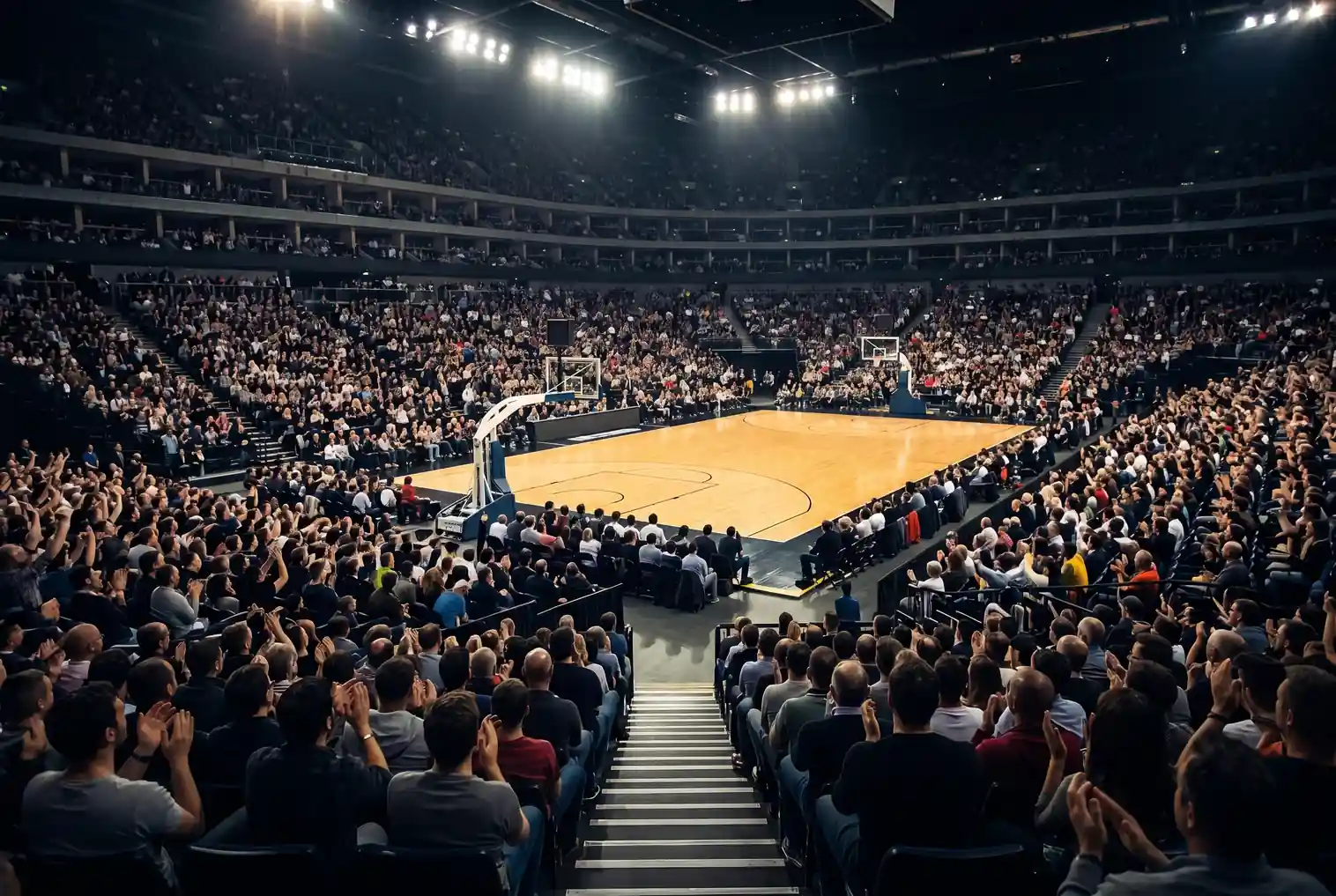
I was on the floor at the O2 the night the NBA came back to London in January. The thing I remember most was not the basketball — it was the queues. Two hours before tip-off, the merchandise stand was three deep. Half the jerseys were European national colours rather than NBA franchises. A guy two seats down had flown in from Lisbon for the weekend. The arena was not a tourist showcase. It was a market signalling its appetite.
O2 Arena attendance
18,424 — highest in NBA London Game history, up 90 percent on 2019.
Social-platform reach
Video from London and Berlin generated over 350 million views — second-most for any NBA Global Games series.
Projected economic impact
£100 m for the combined 2026 NBA programme in London and Manchester.
The 2026 NBA London Game drew 18,424 fans to the O2, the highest attendance in the history of NBA London games and a 90 percent jump on the 2019 edition. Fans bought tickets from 62 countries — a record for any NBA Global Games event — and Berlin and London matches combined produced more than 350 million video views across NBA social platforms, the second-highest tally for any series in the Global Games programme. The Mayor of London’s office projects a £100 m economic impact for the wider 2026 NBA UK programme spanning the O2 and Co-op Live in Manchester.
The broadcast numbers tell the same story from the living room. UK NBA viewership on Prime Video grew 444 percent year on year in 2025-26; Germany grew 455 percent in parallel. Sky Sports’ NBA audiences in the UK are up 40 percent since 2019, with the under-30s driving most of that gain. Around 7 percent of UK internet users now watch NBA games — the lowest figure among the six markets Kagan tracked, but more than three-quarters of them describe themselves as core basketball fans. Crucially, 57 percent of UK NBA viewers are adults under 35, the highest young-adult share in that sample.
The participation numbers underneath matter too. Basketball England’s most recent figures showed roughly 344,400 adults playing basketball at least twice a month — a 50 percent increase on 2021 — and more than 1.2 million children aged 5 to 16 playing weekly. That is a feeder system that did not exist five years ago. Pair it with the EY engagement index move and the picture is consistent: the UK has produced a generation that watches, plays, and follows the league at a level that justifies real commercial investment.
“Long term, I could definitely imagine we could have a division in Europe. And, obviously, this is a very global game. We’re at least a couple of years away from launching it. It would be an enormous undertaking. We continue to feel there are an enormous number of underserved basketball fans in Europe.”
— Adam Silver, NBA commissioner, on the NBA Europe project
The NBA Europe project — a joint venture announcement with FIBA in 2025 — is the longer arc. That timeline matters to a UK NBA bettor for two reasons. The London and Manchester games are pilots for a permanent product, not one-off promotional events. And the futures and tournament markets a UK sportsbook will need to price two seasons from now will look meaningfully different from the ones on the board this winter. The detailed market opening forecasts and the read on which UK books will be quickest to expand their NBA-adjacent boards live in my 2026 London game and NBA Europe road map.
For now, the practical instruction is simple: pay attention to standalone London and Manchester game markets, which UK sportsbooks already price differently from regular-season fixtures. The attendance, attention, and refereeing-novelty dynamics in those single games produce different line behaviour than a Tuesday-night card in Cleveland.
Choosing a UK-Licensed Sportsbook for NBA
I will not name operators, rank them, or rate them. That is not the job of an editorial NBA analyst, and the season-to-season margin between major UK sportsbooks on NBA pricing is smaller than promotional copy would have you believe. What I will do is hand you the checklist I run through whenever a reader asks how to choose where to bet on basketball.
Six questions before you open an account
- Is the operator UKGC-licensed? The Commission’s public register is searchable in under thirty seconds. Roughly 8,234 licensed gambling premises were operating in the UK between April 2024 and March 2025, alongside 5,825 betting shops. Online operators must hold a remote operating licence and display it in the site footer.
- Does the NBA market depth match how you bet? A shallow operator may offer four prop categories on a star and two on the next-best player. A deep one offers fifteen and seven. Open the daily NBA board on a Sunday morning before you commit a deposit.
- Are prices displayed in decimal as standard? Most UK sportsbooks default to decimal but allow fractional or American display. If the toggle is buried, that is a small signal about how the operator treats analytical customers.
- How does the mobile in-play interface behave during a live game? In-play accounts for the majority of basketball handle now. Test the operator on a low-stakes preseason game before you trust them with playoff capital.
- What does the responsible-gambling toolkit look like? Deposit limits, reality checks, time-out, and self-exclusion should all be one click from the account page. The Commission’s enforcement record exists because not every operator gets this right.
- How fast are withdrawals? Anything over 72 hours for a verified UK account is friction the operator has chosen. Read the small print, not the welcome offer.
One non-negotiable rule before any deposit: verify the licence. Offshore operators that target UK customers have grown enormously over the past six years — wagers placed with unregulated UK-facing operators rose from roughly £5 bn in 2019 to £16.6 bn in 2025, and the regulated channel’s share of total UK spend has slipped from 97 to 92 percent. A site that ranks well in a search engine is not the same thing as a site that holds a UK operating licence. The Commission’s public register is the only authoritative answer.
Beyond that, your operator decision should follow your betting style. Spread-and-total bettors care about line consistency and reasonable hold percentages. Prop bettors need market depth and competitive pricing on alternate lines. Live bettors need a fast interface, low latency, and a transparent suspension policy. None of those needs map cleanly onto promotional offers, which is why I treat welcome bonuses as the last filter rather than the first. The bonus is a one-time event. The pricing is what you live with for nine months of basketball.
The Honest Cost of NBA Betting: Limits, Levy, and Loss
A reader emailed me last spring asking why a respectable NBA analyst would devote any column inches to “the boring bit.” Because it is not the boring bit. It is the part of the practice that decides whether you are still betting in five years’ time or whether you are one of the people quietly walking away with a loss they cannot quite tally.
Deposit limits are the simplest tool, and the one with the strongest evidence behind it. The Betting and Gaming Council’s Safer Gambling Week 2025 analysis tracked roughly 11 million safer-gambling messages sent during the campaign — a 75 percent increase on the previous year — and 281,000 deposit limits set by 153,960 different accounts, up 41 percent year on year. Grainne Hurst, the BGC’s chief executive, described the underlying point clearly: “These record-breaking figures underline the industry’s ongoing commitment to raising standards and ensuring the millions of people who enjoy a regular flutter do so in a safe and responsible environment.”
The behavioural data backs that approach. GambleAware’s January 2025 analysis found that 74 percent of potentially high-risk players show detectable behavioural signals roughly 14 days before an operator intervenes. The signals are not subtle — chasing losses with rapid re-deposits, session times creeping upwards, late-night activity around losing nights. The young-adult demographic is the part of the picture that should give every UK NBA bettor pause: roughly 21.9 percent of UK adults aged 18 to 24 score between 1 and 27 on the PGSI, the standard problem-gambling scale; 5.3 percent fall into the highest category. That is the same demographic that drives the majority of UK NBA viewing and the fastest growth in UK basketball engagement.
The tools UKGC operators must provide
Every UK-licensed sportsbook must offer deposit limits, reality checks, account self-exclusion, and a route to GamStop — the national self-exclusion scheme. The statutory levy in force since 1 October 2025 is funding the expansion of research, prevention, and treatment infrastructure behind those tools. The £150 financial vulnerability threshold means an operator will conduct a frictionless check on any account losing more than that figure in a 30-day window. None of those measures are punishments; they are the rails that keep the regulated market worth using.
The honest version of NBA betting for a UK reader is this: it is entertainment with a cost, and the cost is the operator’s margin compounded over hundreds of bets. Setting a deposit limit before the season starts, picking a unit you can lose without changing your week, and walking away from a card when the math is not there are not signs of weakness. They are the practice of an analyst.
Frequently Asked Questions
How does NBA betting in the UK differ from US sportsbook handicapping?
Three practical differences matter. UK operators display decimal odds by default — a 1.91 line tells you the total return per unit staked, where US sportsbooks show -110. UK tip-offs land between midnight and 4am GMT, so late-breaking injury news lands during your sleep. And UK sportsbooks operate under a single regulator with a £150 financial vulnerability threshold, a statutory levy on operator GGY, and an active enforcement programme that includes more than 770 cease-and-desist notices since April 2024. US handicappers work in a state-by-state patchwork and reach a different audience with a different vocabulary.
Which NBA betting market is most popular among UK punters?
Spreads and totals share the lead by volume, with player props now close behind among engaged regular bettors. Live in-play markets account for between 52 and 60 percent of total sports-betting handle in mature European markets and that share is climbing in basketball faster than in any other sport. Among the under-35 audience that drives UK NBA viewership — 57 percent of UK NBA viewers fall in that age band — props and Same Game Parlay have grown fastest, although the post-October 2025 prop restrictions have narrowed the menu on lower-minute players.
What does a decimal NBA price of 1.85 actually imply about the bookmaker’s view?
Divide one by 1.85 and you get 54.05 percent. That is the implied probability the price carries. Strip out the operator’s margin and the trader’s true estimate is closer to about 52 percent. A bet at 1.85 makes mathematical sense if your own honest estimate of the outcome is higher than 54 percent. If it is below, you are wagering at negative expected value regardless of whether the game falls your way. The 1.85 price is the market’s confidence level expressed in a single number; your job is to decide whether you have a better one.
Are NBA prop markets safe to bet on after the October 2025 indictments?
The prop markets currently offered by UK-licensed sportsbooks are tighter and more rigorously monitored than they were before October 2025. Two-way contract players, low-minute role players, and other markets the league considered “too easy to manipulate” — to use Adam Silver’s phrase — were either pulled or restricted by operators. The lines that remain focus on starters and rotation regulars where integrity monitoring is most robust. The federal investigation produced 34 arrests across two cases. Betting on props through a UKGC-licensed operator is meaningfully safer than betting them through an offshore book that does not share customer or wager data with regulators.
What UKGC rules took effect in 2025 that affect NBA bettors specifically?
Four. The £5 per spin slots cap (£2 for 18-24s) took effect in April and May 2025 — slots-specific, but a signal of product-level limits. The financial vulnerability threshold for frictionless checks dropped from £500 to £150 over a rolling 30-day window on 28 February 2025; this catches more regular sportsbook customers than the previous threshold did. The statutory levy on operator gross gambling yield, in the 0.1 to 1.1 percent band, began collecting from 1 October 2025 and funds research, prevention, and treatment infrastructure. And the enforcement programme has tripled criminal cases year on year, with cease-and-desist notices passing 770 since April 2024.
When are NBA games broadcast in the UK, and how does that change live-betting strategy?
Most regular-season fixtures tip off between midnight and 4am UK time, with playoff games sometimes drifting later. Prime Video, Sky Sports, and NBA League Pass carry the broadcast rights, and Prime Video UK viewership grew 444 percent year on year in 2025-26. The practical consequence for live betting is twofold: most UK bettors watch with a 3-15 second stream delay relative to the operator’s data feed, and the live market itself is thinner overnight because recreational money is asleep. Bettors who do well live treat latency as a hidden cost, focus on situational triggers, and either accept a sleep schedule built around the calendar or specialise in pre-game positioning.
The Long Game on the Hardwood
Nine seasons in, the thing I find most striking about UK NBA betting in 2026 is that the basic discipline has not changed even as the surrounding environment has been rewritten. The market is bigger — £15.6 bn of gross gambling yield is a record, and basketball’s share is rising. The audience is younger and growing — 444 percent year on year on Prime Video, 18,424 at the O2, sixth-place sport for Gen Z on the EY index. The rulebook is firmer — £150 affordability checks, the statutory levy, and 770-plus cease-and-desist notices. The prop board is leaner — Rozier, Billups, and the EDNY indictments saw to that.
None of that changes the practice. The bettor who succeeds converts decimal odds to implied probability before placing a stake, tracks closing line value over hundreds of games rather than measuring a season by the last week, stakes flat units he can afford to lose, chooses an operator on pricing and depth rather than welcome offer, and walks away from cards where the math does not back the opinion.
The story for the next two seasons is going to be European expansion. London and Manchester are the proving ground; the NBA Europe project is the multi-year arc. UK sportsbooks will be pricing markets they have not had to price before, and where new markets open, trader mistakes briefly appear. That is where the patient analyst earns. The job is to keep the discipline tight while the opportunity set widens — and to remember, when you sit down on a Tuesday night to look at Wednesday’s slate, that the edge has always come from honest math, not loud opinions.
Created by the ”nba Betting Expert” editorial team.