NBA Staking Plans: Flat Stakes Versus Kelly Criterion
 Available in US
The first time I read about the Kelly criterion, I spent an evening convinced I had been wasting years of betting by sticking to flat stakes. The math was elegant, the theoretical returns were impressive, and the formula promised a precision that flat staking did not offer. The next morning I worked through what Kelly sizing would actually have done to my bankroll across the previous NBA season, and I went back to flat stakes by lunchtime. The math is real; it just does not survive contact with how most UK bettors actually estimate their edge.
Choosing a staking plan is the structural decision that sits underneath every individual bet. The two main approaches in serious sports betting are flat staking and Kelly staking, with several hybrid variations in between. Each has trade-offs, and the right choice for a UK NBA bettor depends on factors that are not always obvious until you have run them against your own betting history.
What Flat Staking Actually Does
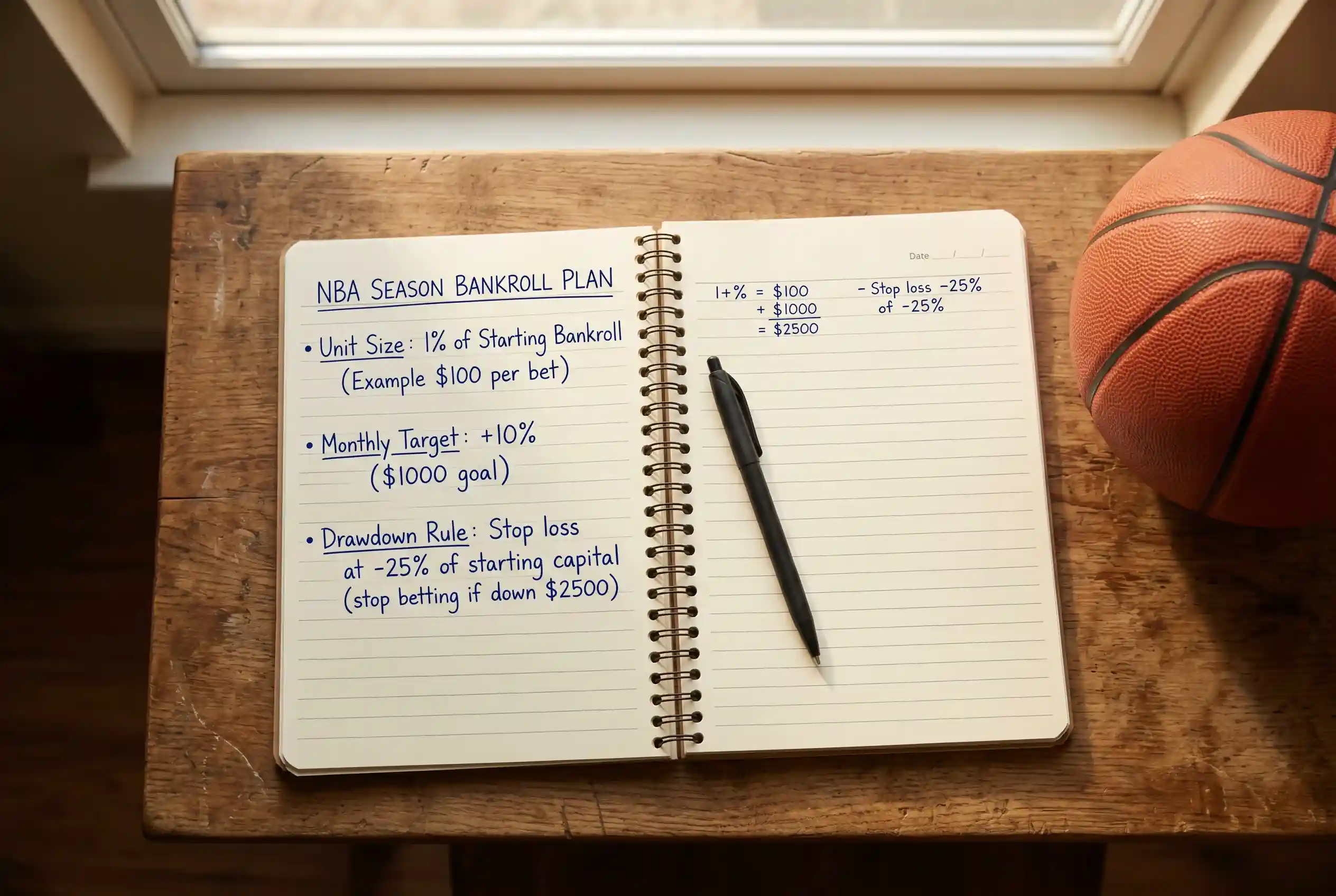
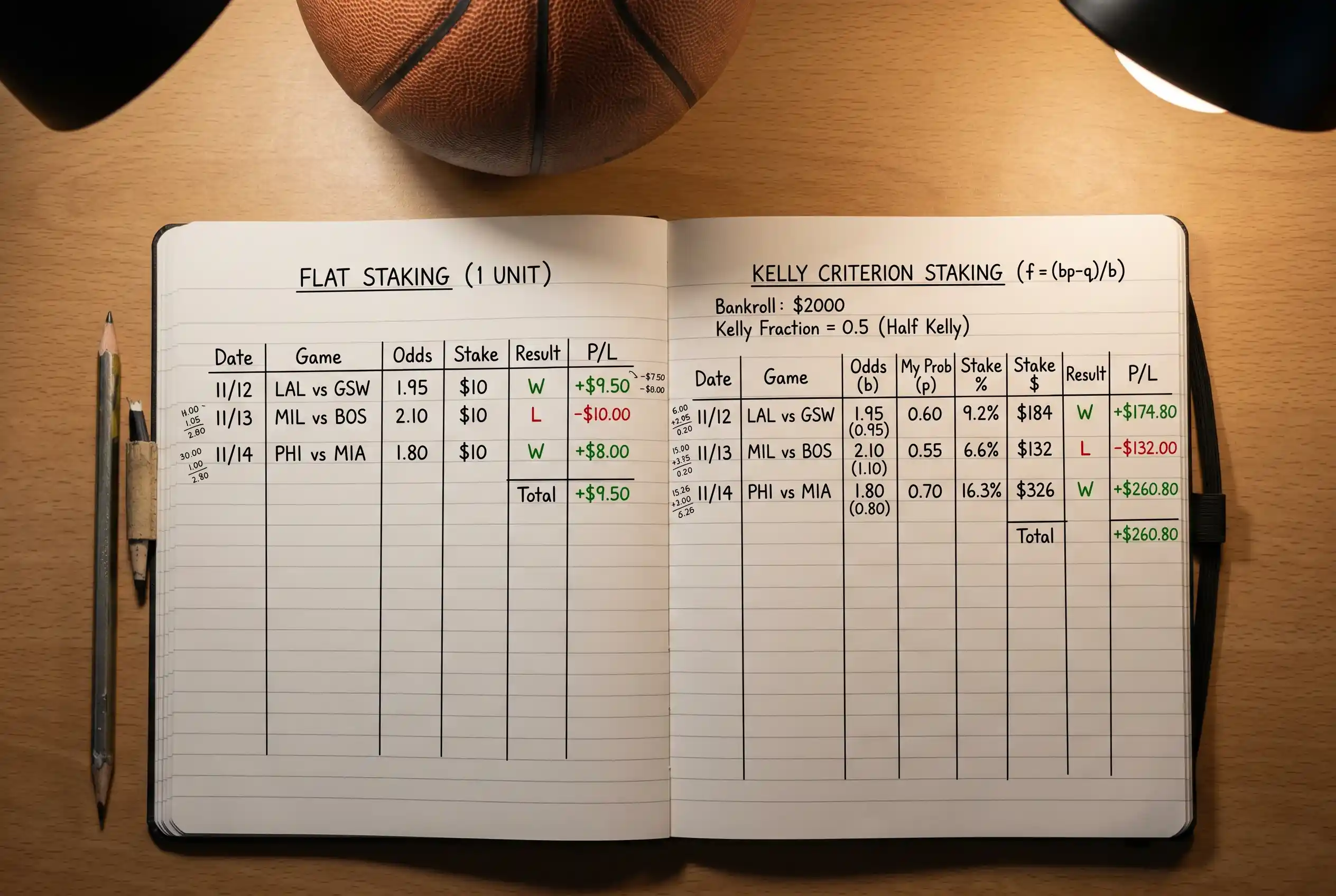
Flat staking is the simplest possible staking plan: every bet is the same size, measured as a percentage of the bankroll at the start of the season or some defined period. A 2 percent flat-stake plan on a £1,000 bankroll places £20 on every bet, regardless of the perceived edge on the specific bet, regardless of the price, regardless of recent winning or losing runs.
The strength of flat staking is its robustness to estimation error. The bettor does not need to know exactly how much edge they have on a given bet; they only need to know the bet has positive expected value. The downside is structural conservatism – a bettor with a genuine 60 percent edge on a specific bet is staking the same amount on it as on a bet where the edge is only 53 percent, which leaves theoretical returns on the table.
In practice, the conservatism of flat staking is its primary virtue. NBA bettors are not perfectly calibrated estimators of their own edge. A bettor who feels 60 percent confident in a bet may genuinely be at 55 percent, with the extra 5 percentage points of confidence being recency bias or wishful thinking. Flat staking limits the damage from these calibration errors because the bet size does not amplify the misestimation.
The other strength of flat staking is psychological. The bettor’s emotional reaction to wins and losses is more stable when the stake size does not change. A losing streak does not trigger sizing changes; a winning streak does not produce overconfidence. The same £20 unit applies whether the bettor is up four units for the month or down four. This stability is more valuable than it sounds, because the emotional rollercoaster of variable staking is one of the most common ways bettors abandon discipline mid-season.
Flat staking is what the overwhelming majority of profitable long-term sports bettors use. The bettors who use variable stakes are usually a specific subset who have done the calibration work to know their edge per bet with reasonable accuracy, and even that subset usually caps the variation tightly.
The Kelly Criterion and Its Math
The Kelly criterion is a formula for determining the optimal bet size given a known edge. The formula in its simplest form is: edge divided by odds-minus-one. If you have a 5 percent edge at decimal odds of 2.00 (a fair price would be 1.91), the Kelly stake is 5 percent / (2.00 – 1) = 5 percent of bankroll on the bet.
The math behind Kelly is elegant. It maximises the long-run logarithmic growth rate of the bankroll, given accurate edge estimates. A bettor with a stable, well-calibrated edge across many bets would, in theory, grow their bankroll faster using Kelly sizing than using flat stakes. The theoretical advantage is substantial – across a year of betting, a Kelly bettor with accurate edge estimates can outperform a flat-stake bettor with the same edge by 20 to 50 percent in expected bankroll growth.
The problem is the “accurate edge estimates” condition. The Kelly formula assumes the bettor knows the true probability of each outcome with precision. The reality is that almost no NBA bettor estimates their edge accurately enough for full Kelly sizing to be reliable. The bettor who thinks they have a 5 percent edge often has a 2 percent edge or a 7 percent edge, and the volatility introduced by Kelly sizing on incorrect estimates produces wild bankroll swings that overshadow the theoretical advantage.
The mathematical demonstration of this problem is straightforward. A Kelly bettor who consistently overestimates their edge by 2 percentage points across their bets effectively bets at twice the recommended Kelly fraction, which is well-known in the betting literature to produce a high probability of bankroll ruin over long horizons. Even small calibration errors compound aggressively in Kelly sizing.
This is why the bettors who use Kelly in serious betting almost always use fractional Kelly – typically quarter Kelly or half Kelly – rather than full Kelly. The fractional approach captures part of the theoretical advantage while providing a buffer against estimation error.
The Fractional Kelly Compromise
Quarter Kelly sizing scales every Kelly recommendation down to 25 percent of the full-Kelly stake. If full Kelly recommends 5 percent of bankroll on a specific bet, quarter Kelly bets 1.25 percent. Half Kelly bets 2.5 percent. The fraction is the bettor’s tunable parameter, allowing them to dial up or down the aggressiveness of their staking based on how confident they are in their edge calibration.
Quarter Kelly is what most professional bettors I know who use any variable staking actually use. The theoretical disadvantage relative to full Kelly is substantial – quarter Kelly captures only about 44 percent of the optimal growth rate – but the practical advantage is large because the variance and ruin probability are dramatically lower.
The way fractional Kelly works in practice is that the bettor estimates their edge for each bet, calculates the full-Kelly stake, divides by four, and bets that amount. A bet with a 3 percent edge at 2.00 prices to a full-Kelly stake of 3 percent of bankroll; quarter Kelly bets 0.75 percent. A bet with an 8 percent edge at 2.00 prices to a full-Kelly stake of 8 percent; quarter Kelly bets 2 percent. The stake varies meaningfully across bets, but the variance is bounded by the quarter-Kelly fraction.
The bettors who make fractional Kelly work do so because they have the analytical discipline to estimate their edge consistently and the bankroll size to absorb the larger stakes on high-edge bets. A bettor without consistent edge estimation will oscillate between under-staking and over-staking in ways that defeat the theoretical advantage.
The Estimation Problem at the Heart of Variable Staking
The honest question every UK bettor needs to answer before considering Kelly or any variable staking plan is: how accurately can I estimate my edge per bet?
The answer for most bettors, including most experienced ones, is: not very accurately. NBA betting is dominated by uncertainty. A given matchup might have a true outcome distribution that produces 51 percent probability of one outcome and 49 percent of the other. A different matchup might produce 56 percent and 44 percent. Distinguishing these two cases with confidence requires deep analytical work and ongoing calibration against actual outcomes.
The bettors who can do this are a small subset of the betting population. They have built models, tracked their predictions, calibrated against outcomes, and refined over years. They are not the average UK NBA punter.
For the average bettor, the safer assumption is that edge estimates have substantial error. Kelly sizing on uncertain estimates magnifies the uncertainty into bankroll volatility that does not respect the long-run optimisation logic. Flat staking does not.
The practical implication is that flat staking is the right choice for almost every UK NBA bettor, including most bettors who would describe themselves as serious. The exceptions are bettors who have done the calibration work, have documented predictions against outcomes across hundreds of bets, and have confirmed empirically that their edge estimates are accurate to within a percentage point or two.
Mobile betting represents around 78 percent of online wagering volume globally, and the friction of variable stake calculation on a mobile interface adds practical drag to non-flat approaches.
When Variable Stakes Earn Their Place
The cleanest case for variable stakes within an otherwise flat-stake framework is a binary distinction between standard bets and high-conviction bets. The bettor uses their normal flat unit for the bulk of their action, and occasionally doubles or triples the unit on bets where the analytical case is unusually strong.
This is sometimes called confidence-based staking or unit-multiplier staking. The bettor designates most bets as 1-unit bets, with a smaller proportion designated as 2-unit or 3-unit bets when the read is unusually strong. The system is simpler than Kelly because it does not require precise edge estimation, just a relative confidence ranking across bets.
The discipline that makes this approach work is keeping the proportion of multi-unit bets low. If the bettor designates 30 percent of their bets as 2-unit bets, the system has effectively become a higher-stake flat-stake plan with extra variance. If the bettor designates 5 percent of their bets as 2-unit bets, the system retains the structural conservatism of flat staking while allowing the bettor to express genuine conviction on the rare bet where it is justified.
The other case for variable stakes is when the bettor genuinely operates in multiple market categories with different inherent edges. A bettor whose prop betting has a documented 4 percent edge but whose moneyline betting has only a 1 percent edge might rationally size the prop bets at 1.5 times the moneyline bet size. This is not Kelly – it is category-level scaling – and it is robust to per-bet estimation noise because the scaling is based on documented multi-season averages rather than per-bet estimates.
Why I Settled on Flat Stakes Permanently
Across nine NBA seasons, I have experimented with multiple staking plans. The two seasons I used fractional Kelly produced higher win rates but worse psychological discipline, because the larger stakes on high-conviction bets dragged my attention disproportionately and produced more reactive thinking on bad outcomes. The seasons I used pure flat stakes produced steadier returns and noticeably calmer decision-making.
The conclusion I have settled into is that staking-plan optimisation is a second-order question. The first-order questions – what to bet, how to estimate edge, when to skip – dominate the long-run results. Flat staking lets me concentrate on those first-order questions without the additional cognitive load of recalculating stake sizes per bet. The theoretical Kelly advantage exists, but it requires analytical precision I do not consistently produce, and the variance it introduces overshadows the gain in my actual betting practice.
For UK bettors who want to test whether they can extract the Kelly advantage, the right approach is to backtest against documented historical bets. Take your last 200 NBA bets, assume the edge estimates you would have made at the time, calculate what quarter-Kelly would have done versus your actual flat-stake results. If quarter Kelly outperforms by a clear margin in the backtest, the bettor has empirical evidence to support the approach. If it does not, the answer is to stay flat.
The other piece of this staking framework is the bet log that allows the backtest to happen in the first place. Without a disciplined log, the entire question of staking optimisation collapses, because there is no record against which to measure anything. I have written through the architecture of a working bet-tracking spreadsheet in my tracking piece next, which is the practical foundation on which any staking-plan decision rests.
The Choice That Compounds
The staking-plan decision feels small in the moment of any single bet. Across a 200-bet NBA season, it compounds into one of the most consequential structural choices the bettor has made. Get it right and the bankroll absorbs variance, the edge expresses itself over time, and the season ends in roughly the position the underlying edge would have predicted. Get it wrong and the bankroll never has the chance to compound, because every bad week resets the practical capital and every good week tempts the bettor into riskier sizing.
Flat staking is unglamorous, and it is what works.
Quarter Kelly is the standard recommendation for bettors who choose to use any Kelly-based sizing. Full Kelly is mathematically optimal only with accurate edge estimates, which almost no NBA bettor produces consistently. Half Kelly is sometimes used by bettors with strong analytical track records, but quarter Kelly is the safer default that preserves most of the practical advantages. The theoretical limitation is real but the practical impact is usually smaller than the literature suggests. Most bettors lose more from poor edge estimation under variable staking than they gain from optimal sizing. The cleaner path to higher long-run returns is improving the underlying analytical work rather than optimising stake sizing on top of inconsistent reads.What is the right Kelly fraction for an NBA bettor to use?
Does flat staking limit my long-run bankroll growth too much?
Created by the ”nba Betting Expert” editorial team.