NBA Player Props UK: Top Betting Markets and Limits
 Available in US
Table of Contents
- Structuring and Pricing NBA Player Prop Lines
- The Five Prop Markets That Dominate NBA Betting
- The Two Numbers That Predict Prop Outcomes
- How October 2025 Reshaped UK Prop Availability
- Building a Personal Projection: A UK-Friendly Worksheet
- Alternate Lines and Why They Matter More Than Main Lines
- Player Props: Quick Questions
- Where the Prop Edge Lives Now

The first prop bet I ever placed in my career as an NBA analyst was on Klay Thompson’s three-point line in a Saturday night game against Sacramento. He had six threes in the previous outing, the line sat at 3.5, and I felt like a genius for twenty minutes — until Steve Kerr pulled him at the start of the fourth with the Warriors up by eighteen. He finished with three. The lesson was unsubtle: a prop bet is not a bet on talent. It is a bet on opportunity, and opportunity in basketball is a thinner thread than most punters realise.
Nine seasons of NBA analysis later, I treat player props as the sharpest tool a UK-facing bettor has on the board. They reward research in a way that game lines do not. They sit in decimal odds across every UKGC-licensed sportsbook I work with, they get sharper data every season, and after the October 2025 federal indictments they have been redrawn — sometimes invisibly — by operators who pulled the most exploitable lines off the menu. This guide unpacks what an NBA player prop actually is, the five markets that matter, the math behind a serious projection, and what changed in the autumn of 2025 that every UK punter should know before clicking confirm.
When projecting a star player’s output, analyzing their NBA usage rate metrics is the most reliable way to predict offensive volume.
Structuring and Pricing NBA Player Prop Lines
An old trading mentor of mine used to say the secret to reading a betting market was to take it apart screw by screw before you ever place a stake. The same logic applies to NBA props. Every prop line is built from five components, and once you can see all five at once, the market stops looking like a coin flip and starts looking like a forecast you can argue with.
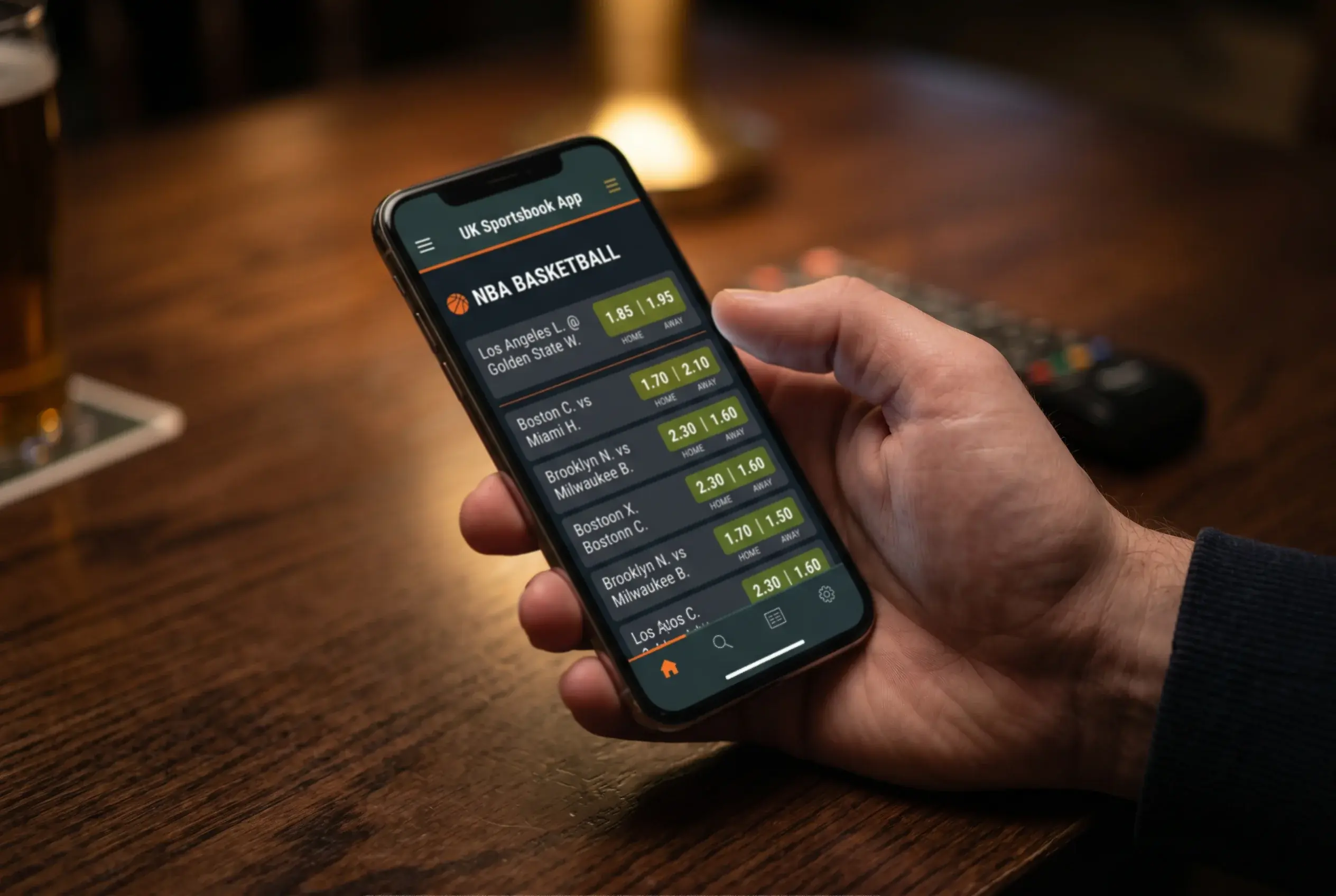
The first component is the statistic itself. Points, rebounds, assists, threes made, steals, blocks, turnovers, double-doubles, triple-doubles — these are the raw stat-lines a sportsbook will price. The second is the player. The third is the threshold, almost always shown to a half-point so that pushes are impossible. The fourth is the choice of over or under. The fifth is the decimal odds attached to each side, which in UK markets sit in a tight band around 1.80 to 1.95 on a balanced line because the operator wants action on both sides at roughly equal volume.
What makes a prop different from a moneyline is that the outcome depends on a single player’s individual production, not the team’s collective result. A team can lose by twelve and still hand you a winning over on the star wing’s points line. That decoupling is the whole appeal. You are not predicting the score of a basketball game; you are predicting the production of one human being inside it.
Basketball commands roughly 28% of total US sports-betting handle on its own — second only to American football — and a substantial slice of that handle now flows through player props rather than the spread. That share has shifted across the last five seasons because props are where casual fans and serious modellers meet on equal terms. The casual punter likes them because the player is the protagonist. The modeller likes them because the inputs are quantifiable.
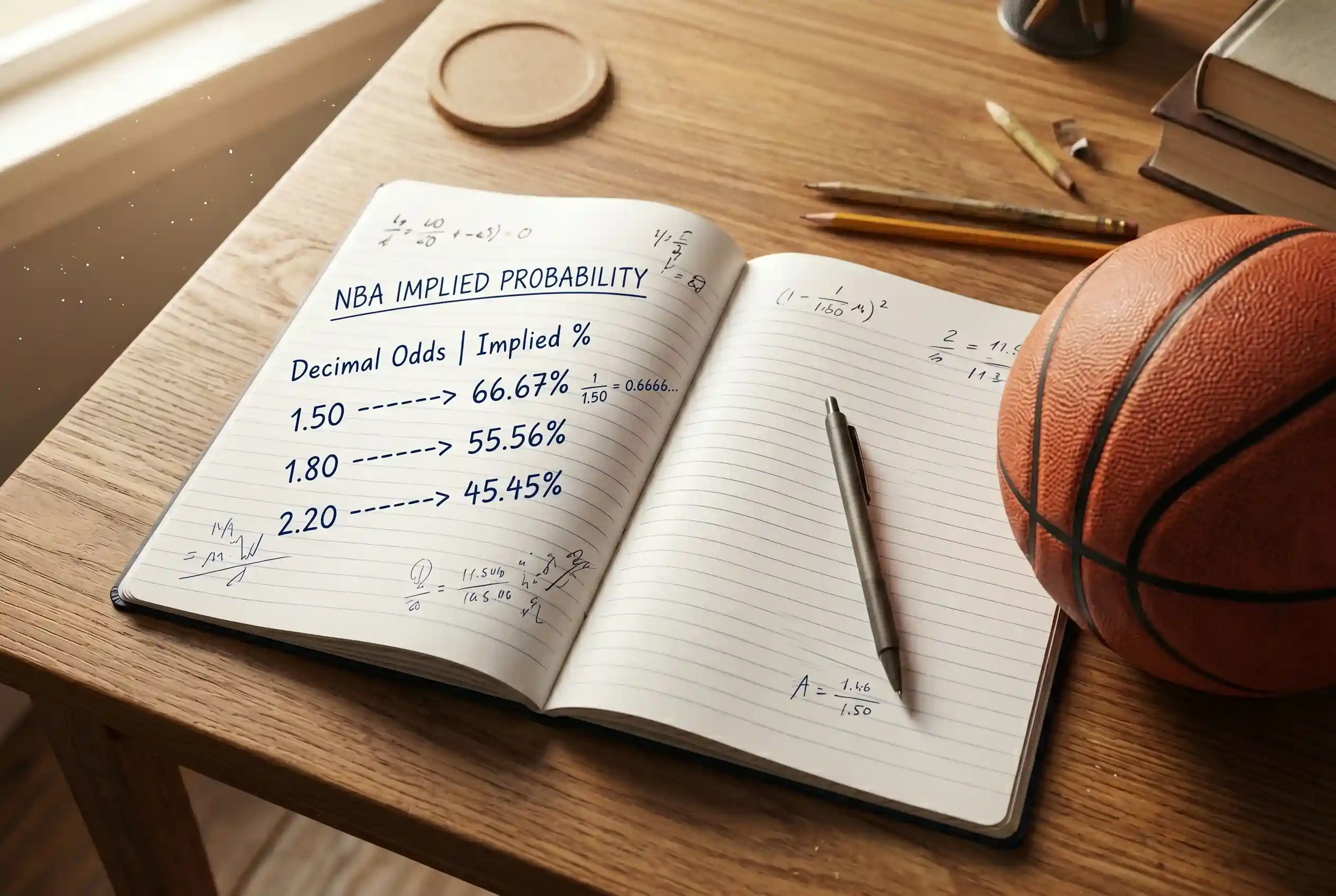
The pricing inside a prop line is where most punters lose without realising it. A line of 24.5 points at 1.85 over and 1.95 under is not a 50/50 proposition with two equal sides. It implies that the sportsbook believes the over is the marginally more likely outcome and is charging you accordingly. To read the line correctly, convert each decimal price into an implied probability — one divided by the decimal odds, expressed as a percentage. Add the two probabilities. You will get something like 105% or 106%. That overage is the margin, the operator’s cut, and it is the headwind every prop bet runs into before tip-off.
Understanding that margin is what separates someone who places props from someone who beats them. The line is not the truth; it is the truth plus a tax. Your job, as a bettor, is to spot the props where your projection is far enough from the line that you still win the bet after the tax. Nothing more glamorous than that.
The Five Prop Markets That Dominate NBA Betting
Walk into any UK-licensed sportsbook’s NBA page on a Tuesday night in March and you will see hundreds of props running down the page. Most of them are decoration. Five markets do the real volume, and those five are the ones worth learning inside out before anything else.
Points are the marquee market. Every starter and most rotation players get a points line, and the half-step granularity (24.5, 25.5, 26.5) means the market reacts hour by hour to injury news, matchup data and projected minutes. A points line is essentially a forecast of usage rate multiplied by minutes multiplied by efficiency, dressed in a single number. The best edge in points props is rarely on the marquee stars — their lines are sharp because everyone is watching — but on the second and third option who steps into expanded minutes when a starter sits.
Rebounds are the most efficient prop to model because rebound rate is one of the stablest individual statistics in basketball. A centre who pulls down 12 a game across forty games has a true mean that wobbles within a narrow range. Where rebound props become tradeable is in the opponent matchup: a team that misses a lot of shots creates more rebound opportunities, and a slow-paced opponent reduces the total rebound pool. Track the opposing team’s opponent-field-goal-percentage and pace, and you will see rebound lines that look mispriced more often than you expect.
Assists are the trickiest of the five. Assist totals depend on teammates’ shotmaking — a point guard can run a perfect set, find a shooter in rhythm, and still walk away with no credit because the shot rims out. The volatility in assists comes from the people the player passes to, not from the player. That makes assist props heavily matchup-dependent. When a primary handler plays alongside hot shooters at home, the over has tailwind; on the road, with cold shooters, the under is the lean.
Three-pointers made is the modern prop, and it is the one most reshaped by the post-October 2025 changes. Operators saw too many low-volume shooters being manipulated and have tightened their offerings. For starters who attempt eight to ten threes a night, the prop is liquid and reasonable. For low-minute role players, the line has often disappeared entirely. When the prop is on the board, read the opposing team’s three-point defence and corner-three rate before anything else — those two numbers move three-point props more than anything the shooter himself does.
Points-rebounds-assists combos, usually written as PRA, are the fastest-growing prop on UK sites. They sum a player’s three core counting stats into a single line, and they offer a smoother distribution than any of the components alone because volatility in one stat tends to be offset by volatility in another. A guard who underperforms on points often racks up assists, and vice versa. PRA props reward bettors who can read role players and rotations because the floor is more predictable than the ceiling.
Basketball alone accounts for around 14.2% of global online sports-betting revenue, and props now drive a disproportionate share of that handle in regulated markets. Knowing which five markets soak up most of the action lets you ignore the noise of fifty alternate props and focus on the lines that move.
The Two Numbers That Predict Prop Outcomes
Ask me which two numbers I check first when I open a slate of prop lines, and the answer is always the same: usage rate and projected minutes. Everything else — efficiency, matchup, rest — adjusts the projection. These two set it.
Usage rate measures the percentage of a team’s possessions that end with a specific player taking the shot, drawing the foul, or turning the ball over while he is on the floor. A primary scorer typically operates at 28% to 32% usage. A high-usage star running heliocentric offence can push above 35%. A role-player wing might sit at 14% to 18%. The number tells you how often a player is the one finishing a possession, and that is the input that turns minutes into counting stats.
Minutes are the simpler variable, but they are the one that gets ignored most often. A player who averages 32 minutes a night is not going to play 32 minutes in every game. Coaches manage matchups, foul trouble, blowouts, and back-to-back fatigue. A starter on the second night of a back-to-back routinely loses three to five minutes. A bench player whose direct backup is out can pick up six. Read the pregame minutes projection in light of who else is in the rotation, not the season average. The official NBA injury report often gives the clearest signal before tip-off, and on UK time, you usually get a clean look at it.
The mental model I use is simple: usage tells you the player’s slice of the production pie when he is on the floor, and minutes tell you how big the pie is on the night. A small slice of a big pie can still beat a big slice of a small pie. The number that pops out the other end is your expected production, and if it sits clearly above or below the operator’s line, you have the start of a bet.
The deeper math behind usage rate — how it is calculated possession by possession, how it shifts when stars sit and how primary handlers absorb workload — is its own subject, and I do not want to compress it into a few paragraphs here. The point of this section is the principle: usage times minutes is the foundation, and every other adjustment is a tweak on top.
How October 2025 Reshaped UK Prop Availability
On the morning of 23 October 2025 I opened my laptop in London, scrolled through the NBA prop board on the UK site I was tracking that week, and noticed something that had not been there the night before. A swathe of two-way contract players had been removed from the prop menu entirely. No points lines, no rebounds lines, no threes. Half an hour later the FBI press conference began, and the reason for the disappearance walked onto the screen in the form of 34 arrests across 11 states.
The federal indictments out of the Eastern District of New York that day were the biggest betting-integrity story in NBA history. Thirty-four people arrested, four major mafia families named in the prosecutors’ filings, and tens of millions of dollars said to have moved through the schemes. Terry Rozier of the Miami Heat was alleged to have leaked information about his own playing availability across at least seven games between March 2023 and March 2024, with associated wagers said to total roughly $200,000. Chauncey Billups, the head coach of the Portland Trail Blazers, was charged in a separate but related case involving wire fraud conspiracy and money-laundering conspiracy tied to rigged poker games.
Commissioner Adam Silver did not soften the framing in his first public response. “My initial reaction was I was deeply disturbed,” he told Amazon Prime Video. “There’s nothing more important to the league and its fans than the integrity of the competition, so I had a pit in my stomach. It was very upsetting.” A few weeks later, at the NBA Cup final press conference in Las Vegas, he was blunter about the league’s commercial calculus: “I mean it when I say, if this game isn’t viewed as being honest and the competition being on the level and at the highest integrity, over time we will lose our fan base.”
Inside two weeks Silver was on the record about what would change at the betting-market level. “We’ve asked some of our partners to pull back some of the prop bets,” he said. “Especially when they’re on two-way players — guys who don’t have the same stake in the competition — where it’s too easy to manipulate something that seems small and inconsequential.” That was the public confirmation of what I had already seen on my screen. UK-licensed operators, which take their integrity-monitoring feeds from the same firms as their US counterparts, applied the changes almost immediately.
What that means in practice for a UK punter today is that you will see fewer prop lines on low-minute and two-way players, particularly for under markets where a player can underperform a tiny line by simply being benched. You will see more conservative limits on alternate-line tickets that combine multiple low-volume players. And you will see operators delay posting some props until the official inactive list drops, because that is the window in which manipulation became hardest to police.
The longer the post-scandal era runs, the more I think it has done the UK prop market a favour. The lines that survived the cull are sharper, the limits are healthier, and the operators with serious integrity teams now look very different from the ones that did not bother to invest. A bettor who lived through this autumn watched the menu shrink and the market quality rise at the same time — an exchange most of us would take.
Building a Personal Projection: A UK-Friendly Worksheet
I keep a single spreadsheet for every player I bet on regularly. It has fewer columns than you might expect. The reason it works is not the columns themselves; it is the discipline of filling them in before I look at the prop line. That order matters more than any single input.
Start with the player’s season usage rate. Pull it from the league reference of your choice and write it as a decimal — 0.27 for a 27% usage rate. The number is more stable than people assume. A starter who has played thirty games at 27% usage will still be at roughly 27% usage in his thirty-first, barring a major lineup change. Treat anything published before twenty games as noisy.
Next column: projected minutes. Not season average. Projection for tonight. Open the team’s depth chart, check who is in and who is out, look at last night’s schedule to flag back-to-back fatigue, and write the number you actually expect. If a starter is questionable and likely to play but on a soft minutes restriction, write 26 rather than his usual 32. If a starter is out and his understudy is moving into the role for the first time, write a conservative number and revise after one or two games.
Third column: efficiency for the relevant stat. For points, this is points per minute, or, if you want a slightly more sophisticated input, true shooting percentage applied to projected shot attempts. For rebounds, it is rebound rate adjusted by the opponent’s pace and shooting profile. For assists, it is assists per minute filtered through teammates’ three-point shooting. The exact formula matters less than picking one and applying it consistently.
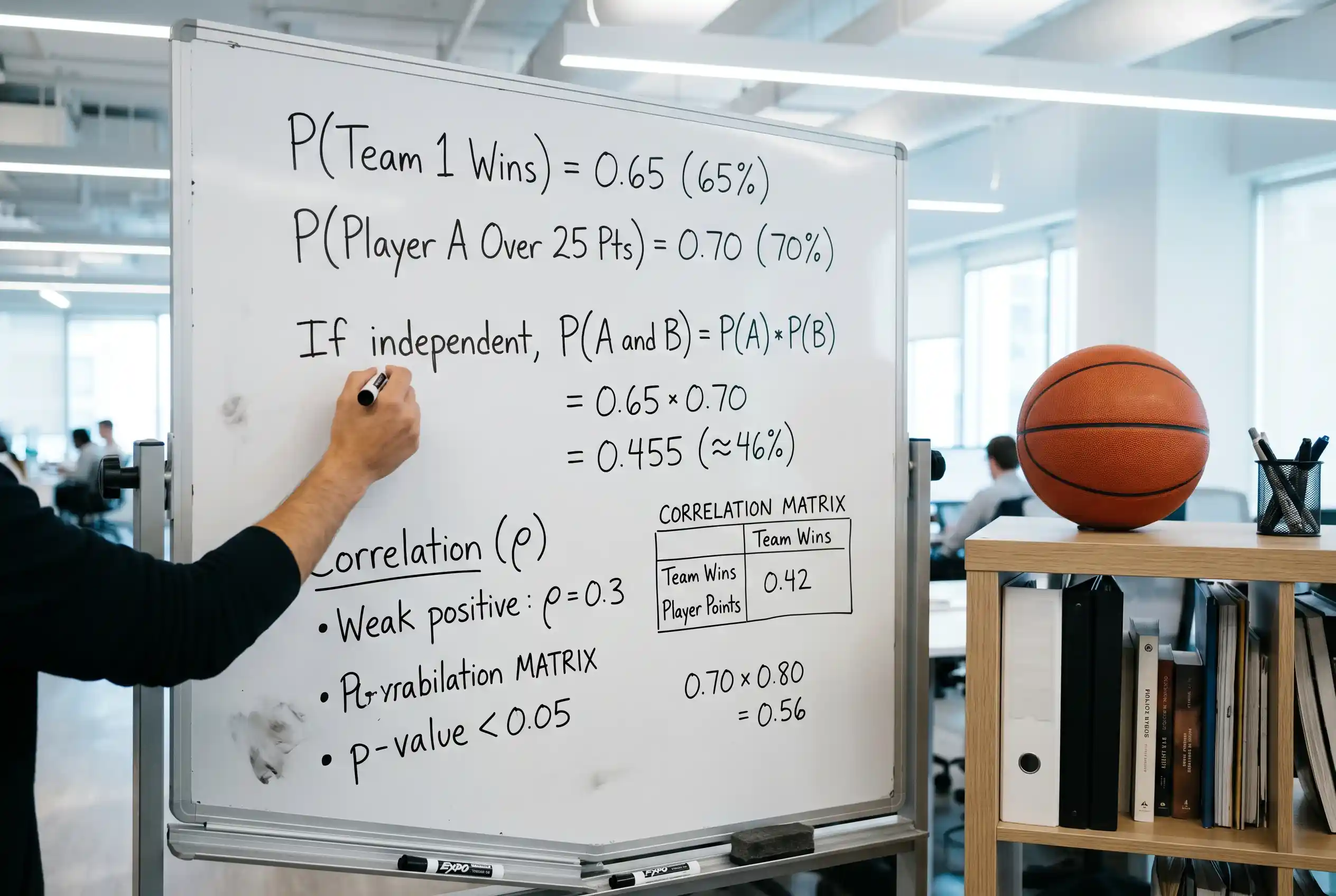
Multiply usage rate by projected minutes by efficiency, and you have your projection. Compare it to the line. If the line sits half a standard step above your projection, you have a soft signal for the under. A full step is a stronger signal. Two steps is the kind of gap that makes me re-check my own math, because operator pricing is rarely that wrong on a public player.
The last step is the one most punters skip. Convert the line’s decimal odds to implied probability and ask whether your edge survives the margin. A 1.85 line implies about 54.1% probability. If your projection says the under hits 56% of the time, you have a real but thin edge. If it says 65%, you have something worth a unit. If it says 51%, walk away — that is not edge, that is variance dressed up as conviction.
Worksheets work because they force the bettor to commit to a number before the line tempts them. The temptation in props is always the line: a number that looks slightly low or slightly high invites a snap judgement that has nothing to do with the player’s actual production curve. Writing your number first inoculates you against that. You stop betting against the line and start betting against your own forecast, which is the only forecast you can hold yourself accountable to over a long season.
Alternate Lines and Why They Matter More Than Main Lines
The most underrated tool on any NBA prop page is the alternate-line menu, and the punters I respect most spend more time there than on the main board. The reason is simple: the main line is priced sharp because every casual bettor in the country sees it. The alt lines are priced from a model, and models sometimes have soft edges.
An alternate line is the same prop with a different threshold. If the main points line on a star is 27.5 at 1.90 each way, the alt menu will offer overs at 24.5, 25.5, 26.5, 28.5, 29.5, 30.5, and so on, with the decimal odds shifting accordingly. Cross to the under side and you get the same staircase running the other way. The operator has built the alt menu by taking its true projection and walking it up or down the curve.
Where the value lives is in the extremes. If your projection has a player at 26 points with high confidence, the main 27.5 over at 1.90 is a thin under play. But the alt over 24.5 at, say, 1.45 might be a better bet relative to your read of the floor of his production. Conversely, if you have strong conviction on the ceiling — for example, a star going off in a revenge game with no defensive support on the floor — the alt over 32.5 at 4.50 can be a genuine value play even though the implied probability looks daunting.
Alt lines reward bettors who can specify which part of a player’s distribution they are betting on. Main lines lump the whole curve into a single yes-or-no. Alt lines let you isolate the tail.
The trap inside alt lines is parlaying them together. Operators happily build same-game parlays from alt props, and the headline payout looks enormous, but each leg’s margin compounds. A four-leg same-game parlay on alt props can carry a built-in vig of 25% or more once you devig each leg. Single alt bets are the value play. Stacked alt parlays are the operator’s profit play.
Player Props: Quick Questions
Which NBA player prop categories did UK sportsbooks restrict in late 2025?
After the October 2025 federal indictments, UK-licensed operators followed the NBA’s request to pull back prop offerings on two-way contract players and low-minute role players, particularly under markets where a player could underperform a small line through being benched. Some books also tightened limits on alternate-line combinations and delayed posting certain props until the official inactive list was confirmed. Main props on starters and rotation players remained available.
Why are some two-way player props no longer offered by UK sportsbooks?
Two-way contract players move between the NBA and the G League, often play limited minutes, and have less long-term incentive tied to NBA competition than fully rostered players. The combination made their prop lines easier to manipulate, which is exactly what the federal indictments alleged. Adam Silver publicly asked sportsbook partners to pull such props back, and UK operators applied the change to align with their integrity-monitoring partners.
How are NBA points props priced compared to rebounds and assists?
Points props are typically the most liquid, with the tightest spreads and the deepest alternate-line menus, because points are the highest-variance counting stat and attract the most public action. Rebound props are priced from a more stable underlying distribution and often offer cleaner value on matchup reads. Assist props carry the widest variance because they depend on teammates’ shotmaking, so their prices tend to be slightly looser, which can cut both ways for the bettor.
Can I bet on a single NBA player’s three-pointer total in the UK?
Yes, three-pointers made is a standard prop market on most UK-licensed sportsbooks for starters and high-volume bench shooters. The post-October 2025 changes have narrowed the offerings on low-volume players, but for any rotation player attempting six or more threes a night you will still find a main line and a full alternate-line ladder on the menu.
Where the Prop Edge Lives Now
Nine seasons in, my honest read on the UK NBA prop market is that it has never been a better place to find edge — and it has never been a more disciplined place to play. The post-October 2025 cleanup removed the lines that were attracting the worst actors, sharpened the lines that remained, and forced operators to invest in monitoring infrastructure that the casual bettor will never see but absolutely benefits from. The market is leaner and the menu is shorter, but the lines that are left are the ones worth working.
If I could give a returning punter one piece of advice for the rest of the 2026 season it would be this: ignore the marquee main lines on the marquee stars. Those lines are sharp, the public is on them, and the margin is the same as everywhere else. Find the second and third options on rosters where a primary scorer is questionable. Read the minutes projection before you read the line. Work the alt menu, not the parlay menu. And keep your worksheet open before you open the sportsbook tab. Where the edge lives now is on the players nobody else has done the math on.
Discover more profitable angles and expert player projections at CourtLine.
Created by the ”nba Betting Expert” editorial team.