
NBA Championship Futures UK: Outright Betting Odds (2026)
 Available in US
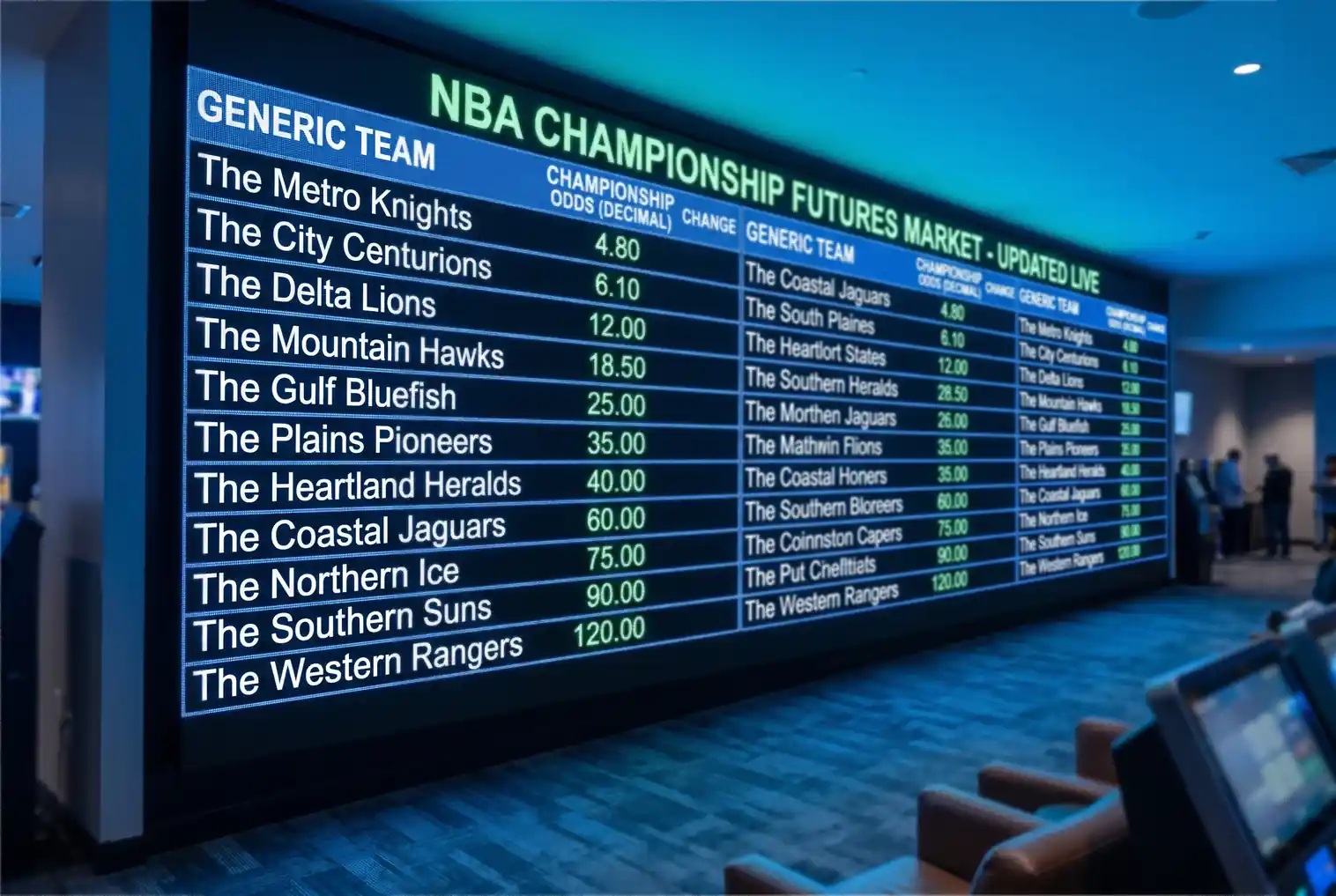
Every July, the day after the previous NBA Finals concludes, every UK-licensed sportsbook posts an opening championship futures board for the next season. Thirty teams, thirty prices, often before the draft has finalised and well before training camps open. I save a screenshot of every opening board I see, because comparing those July prices to the prices nine months later in March is the single best education a UK NBA bettor can give themselves on how this market actually moves.
The championship futures market is the largest, most-bet, and most heavily marketed NBA futures product. It is also the most analytically interesting board on the entire NBA betting landscape, because the prices reflect a blend of statistical modelling, voter narrative, and recreational sentiment that rarely settles cleanly on a single team’s true probability. The serious UK bettor’s job is to find the gaps.
Analyzing NBA Championship Futures Board Construction
The opening championship board is built from each operator’s preseason power ratings, adjusted by the volume of action the book expects on popular teams. The biggest brands run sophisticated models that produce a baseline championship probability for every team, but the displayed price is not just that probability with margin added. It is the probability adjusted for the expected betting volume on each team, with prices on heavily backed teams trimmed and prices on lightly backed teams lengthened.
This is why the headline favourites – the teams everyone is talking about as contenders – often look short-priced relative to what their genuine probability would justify. The book has trimmed those prices because the volume of action flowing to them creates liability that needs to be balanced. The corollary is that the second-tier and third-tier contenders, the teams that get less mainstream coverage, often sit at prices longer than their genuine probability would justify.
The full board carries a combined margin of 30 to 45 percent, depending on the book and the time of year. The largest, sharpest UK operators tend to sit at the lower end of that range. The smaller and newer operators often run wider margins, sometimes north of 50 percent on the championship board. This is one of the markets where line shopping across operators meaningfully changes expected value.
To devig the board, sum every team’s implied probability, then divide each team’s probability by that total. The result is each team’s no-vig fair championship probability according to the book. A team priced at 10.00 (10 percent implied) on a board with a 40 percent combined margin sits at a devigged probability of 10 / 140 = 7.14 percent. That is the book’s honest estimate of the team’s championship chance.
The team you are considering betting needs a true championship probability you estimate at meaningfully higher than that devigged figure. Three to five percentage points is the threshold for a clearly value bet on a futures position, because the long horizon and wide margin both compress small edges below what is worth tying up capital for.
The Tiered Structure of the Modern Championship Board
The championship board sorts into four practical tiers, and the value opportunities differ in each.
The first tier is the top three or four teams priced shorter than 8.00. These are the consensus contenders – teams with established cores, deep rotations, and a recent playoff pedigree. The action volume on these teams is enormous, and the book has typically priced them tightly or slightly worse than fair. Value at this tier is rare. Bettors who play here are usually doing so for the narrative engagement rather than the edge, or for a specific late-season position when a contender has stumbled and re-priced upward briefly.
The second tier sits at 8.00 to 25.00. These are the next group of contenders – teams whose championship case requires specific things to break in their favour but who are genuinely in the conversation. This is the tier where I have found the most consistent value over the years. The recreational money flows more sparsely here, the book’s pricing model has more uncertainty, and the longer prices offer meaningful upside if the team’s case develops favourably.
The third tier sits at 25.00 to 100.00. These are the dark-horse candidates – teams whose championship case requires several things to break right but whose prices are long enough that occasional bets can return outsized payouts. Value is harder to identify here because the book’s margin is often disproportionately heavy on long-shot prices, and because the recreational money that flows in tends to inflate the prices on the most popular dark horses (the team with a famous star, the team with a buzzy free-agent acquisition).
The fourth tier sits at 100.00 and longer. These are essentially lottery tickets, and the math almost never supports betting them seriously. The book is offering 200.00 on a team whose true championship probability is closer to 0.1 percent. The implied probability at 200.00 is 0.5 percent, comfortably worse than the fair price. Long-shot tickets in this tier are recreational rather than analytical bets.
Sports betting globally is on track for $187.39 billion by 2030, growing at 11 percent a year, and the futures category is one of the higher-margin chunks of that growth. UK operators have invested in marketing the championship board because the long-horizon nature of the product produces sticky engagement – a punter with an active championship ticket comes back to the operator’s app multiple times per week to check their position.
Where the Value Has Sat in Recent Seasons
The pattern that has held across the seasons I have tracked is that the championship favourite priced at 5.00 to 7.00 in October finishes the season at roughly fair value, while the second-tier contenders priced at 12.00 to 20.00 in October produce the most consistent positive expected value on the board.
The mechanism is straightforward. The favourites attract the most action and have the tightest pricing. The second-tier teams attract enough action that the books are honest about pricing them but not so much action that the prices get trimmed below fair. The result is that bets in the 12.00 to 20.00 range, on teams with genuine contender credentials, have consistently outperformed bets on the headline favourites across a multi-season window.
The other consistent pattern is that conference futures – betting a specific team to win the Eastern or Western Conference rather than the championship outright – offer better expected value than championship futures in many cases. The book has to balance their book on the conference market separately from the championship market, and the second-tier contender’s conference futures price often reflects less recreational distortion than their championship price does. A bet on a Western Conference contender to win the West at 4.00 may offer better expected value than the same team to win the championship at 8.00, if the contender’s likelihood of winning the conference is materially higher than the implied probability and their likelihood of winning the Finals once there is closer to fair.
The trade deadline in February is the single most reliable line-movement event of the entire championship futures lifecycle. A team that adds a star at the deadline typically sees its championship price compress by 30 to 50 percent within the following week. A team that sells off sees its price lengthen meaningfully. Bettors who have positions before the deadline, especially on teams that look like deadline buyers, often see substantial paper gains in February.
Hedging the Winning Position
The hedging question on a championship futures bet is the most consequential decision of the entire bet’s lifecycle, and most casual punters get it wrong by reflex.
A futures ticket that has worked through the regular season and into the playoffs has appreciated dramatically in value. A 14.00 preseason ticket on a team that has reached the conference finals is now worth more than ten times its original cost – maybe much more, depending on how the bracket has played out. The bettor faces a genuine decision: hold for the full payout if the team wins, or hedge by laying bets against to lock in a partial profit.
The mathematically correct answer depends on three things: the ticket’s current paper value relative to the bettor’s bankroll, the bettor’s risk tolerance, and the genuine probability that the team will close out the championship. The pure-EV answer is usually to hold the ticket if the implied closing probability is roughly fair, and to hedge if the closing prices for the team have compressed below fair value through playoff success.
The practical answer for most bettors is to hedge partially. A position worth 30 percent of bankroll on a single binary outcome is uncomfortable for most punters regardless of the math, and locking in a portion of the profit by betting against allows the remainder of the position to run for the full payout without the same psychological weight.
The mistake I see most often is bettors who fail to hedge on a position worth 50 percent or more of their bankroll and then watch the ticket evaporate when their team loses Game 7 of the Finals. That happens. The hedging decision is not about expected value alone – it is about whether the bettor can absorb the all-or-nothing outcome psychologically and financially.
The other dimension of playoff position management is the broader question of how to bet the playoffs themselves, separate from the futures position. The structural differences between regular-season and playoff betting are significant enough to require their own framework, which I have written through in my playoff betting piece.
The Long-Term Discipline of Futures
The championship futures market rewards a specific kind of patience. The bettor who places three to five carefully chosen tickets each preseason, sized at 1 to 2 percent of bankroll each, and lets them run through the season without overreacting to short-term price movements is doing the analytical work the market rewards. The bettor who chases hot starts, fires impulse bets after big trades, and never writes down a thesis is doing the work the market punishes.
The discipline of writing the thesis at placement is what I would emphasise above everything else for any UK bettor new to futures. The bet was placed for a reason. Eight months later, when the team’s situation has shifted multiple times and the price has moved through several phases, the original thesis is the only honest reference point for whether the bet still belongs in your portfolio. Without that anchor, the bettor’s decision-making becomes reactive rather than principled, and the structural advantages of the futures format quietly disappear.
The combination of long resolution horizons and broad outcome distributions means the book is taking liability across many possible scenarios for months on end. Wider margins compensate for this exposure. Major UK operators typically run combined margins of 30 to 40 percent across the championship board, with smaller operators sometimes ranging higher. Line shopping across operators is meaningful here because the margin difference compounds across a multi-month hold. Often yes. The conference futures market is priced separately from the championship market, and the book’s balance considerations differ. Second-tier contenders in particular often have conference futures prices that reflect less recreational distortion than their championship prices. The trade-off is a lower headline payout, but the expected value can be meaningfully better in many cases.Why do championship futures markets have such wide margins?
Is it worth betting a team to win their conference rather than the championship?
Published by the nba Betting Expert team.