
NBA Bankroll Management for UK Bettors
 Available in US
The second NBA season I bet seriously, I doubled my bankroll between October and Christmas, then lost the lot by the All-Star break. The reads were not the problem. My win rate held up through the wipeout. What killed me was that I had started betting 5 percent of my bankroll per game in November, then 8 percent in December when my confidence grew, then 12 percent in January when I needed to recover after a bad week. By February I was placing bets that risked a fifth of what I had on individual NBA games, and one bad weekend wiped out everything.
Bankroll management is the part of NBA betting that nobody markets, nobody features on the homepage, and almost everyone underrates. It is the discipline that separates a bettor whose edge actually translates into profit from a bettor whose edge gets eaten by variance. For UK NBA punters, where the season runs 82 games per team plus playoffs and the volume of betting opportunities is enormous, getting bankroll management right is more consequential than any single analytical insight.
Sizing the NBA Season Bankroll
The first decision is how much money to allocate to NBA betting in the first place. This is a question that has no single right answer, but it has several clearly wrong ones.
The wrong answers all involve money you cannot afford to lose. The bankroll should never include money earmarked for rent, bills, savings goals, or family obligations. The bankroll should never be funded by credit. The bankroll should never represent a sum whose loss would meaningfully change your living situation or financial trajectory. These are not moralistic warnings – they are operational requirements, because the decision-making quality of a bettor who is risking essential money degrades immediately and severely.
The right answer is a discretionary entertainment budget that you have set aside specifically for betting, and that you would otherwise spend on other entertainment. For most UK NBA bettors I know, that sum is somewhere between £500 and £5,000 for a full season, with the median sitting closer to £1,000 to £2,000. The bankroll is what you can afford to lose if your edge does not materialise or if variance runs heavily against you.
The season is the right unit of time for sizing the bankroll. NBA betting has its own rhythm – preseason analysis, regular season grind, playoff intensity, offseason reflection – and the bankroll should match that rhythm. A bettor who has set their bankroll for the season can think clearly about the long horizon. A bettor who tops up their account every week to keep betting after losses has effectively no bankroll discipline at all.
The structural starting figure I would offer to a UK punter new to serious NBA betting is to commit a fixed sum to the season, deposit it across two or three regulated UK operators (no single operator should hold the entire bankroll for line-shopping reasons), and treat that sum as the analytical universe for the season. Wins extend the bankroll; losses contract it; replenishment between seasons is the only acceptable model for sustained bankroll discipline.
Defining the Unit and Sticking to It
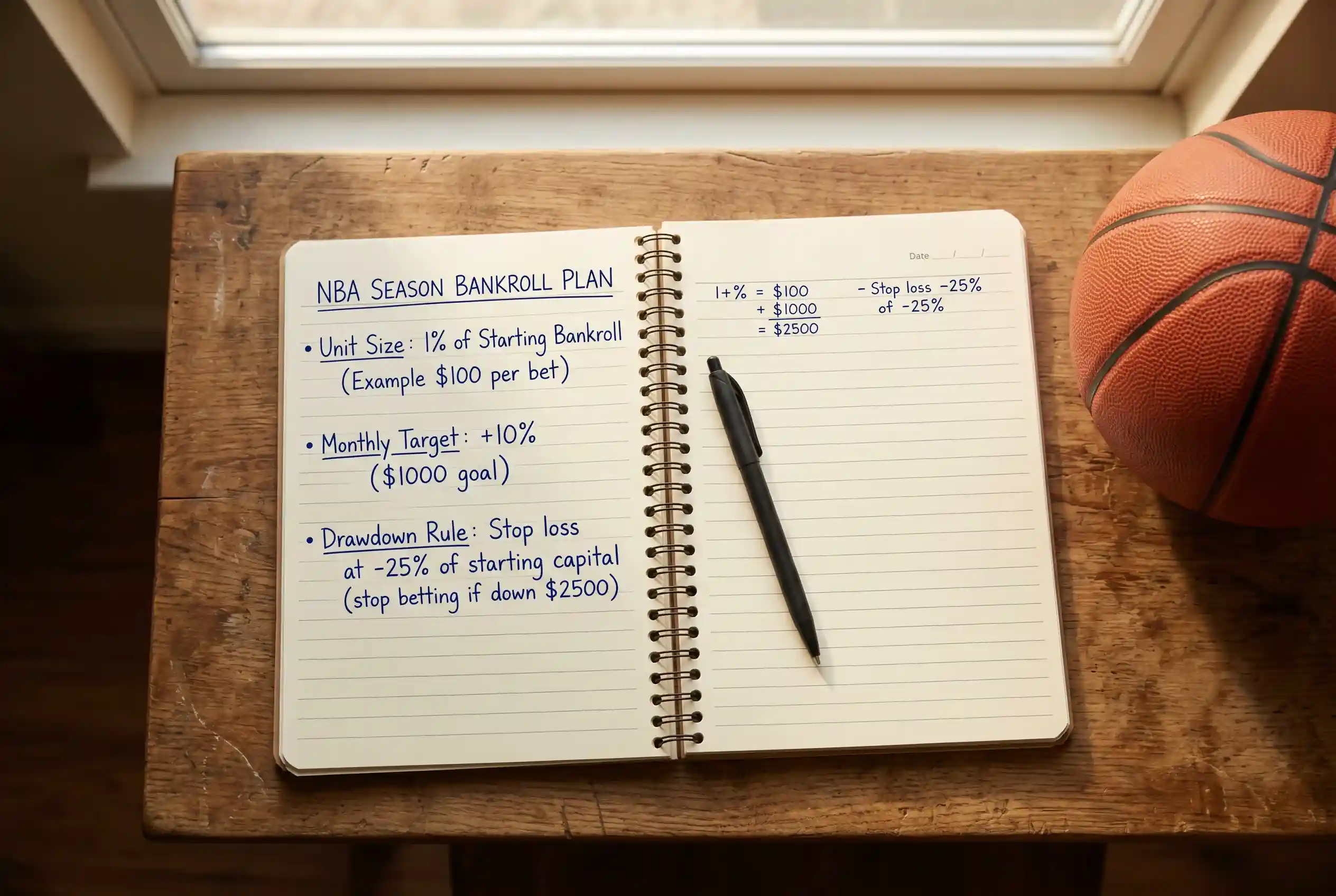
The unit is the percentage of bankroll you risk on a single standard bet. The right unit size for most UK NBA bettors is 1 to 2 percent of bankroll. The wrong unit size is anything that varies based on the bettor’s confidence in the specific bet.
A 2 percent unit on a £1,000 bankroll is £20 per bet. That feels small to many bettors when they first sit down. It feels appropriately sized after the first 100 bets, when the variance of the betting season starts to bite. The bettor who has been betting 2 percent units through a 20-bet losing streak still has a meaningful bankroll. The bettor who started at 5 percent units has lost half their capital and is now psychologically pressured to chase, which is when serious damage happens.
The unit should be sized once at the start of the season and held constant. The temptation to size up after a winning week is real and dangerous. The temptation to size up after a losing week to recover is even more dangerous. Both temptations operate on the assumption that the bettor’s edge has somehow changed, when in reality only the variance has shifted. A consistent unit size lets the edge compound across the season; an inconsistent unit size produces volatility that overwhelms whatever edge exists.
The 2 percent unit is appropriate for bettors with a clear edge – a documented win rate above 53 percent on bets priced near 1.91, or a structural advantage in a specific market category. Bettors who are still developing their edge or testing new analytical approaches should size down to 1 percent or smaller, because the lower unit gives more room to absorb the variance of learning without ruining the bankroll.
The 24 percent of UK adults who place sports bets monthly do so primarily as recreational entertainment. The unit-based discipline I am describing is for the smaller subset of UK punters who treat NBA betting as a long-horizon analytical pursuit.
The Drawdown Rule
The other essential bankroll discipline is the drawdown rule – the threshold at which you stop betting and reassess. Every serious NBA bettor I have spoken with has some version of this rule, and the most useful versions are clear and pre-committed.
My personal rule is a 20 percent drawdown from peak bankroll. If my bankroll falls 20 percent from its high-water mark during the season, I stop placing new bets for a defined period and review everything. The review is honest: am I making analytical mistakes I can identify, am I sizing bets correctly, am I being tilted by recent losses into worse decisions? The pause lets the review be analytical rather than reactive.
The 20 percent threshold is not magic. It is calibrated to a 2 percent unit size, which means the threshold is reached after roughly 10 unit-losses if no wins offset them. That is a heavy losing streak by any measure, and if it happens, something is worth examining. Bettors with tighter unit sizes might use 15 percent; bettors with wider units might use 25 percent.
The point of the rule is not the specific number – it is the act of pre-commitment. A rule decided in advance protects the bettor from the worst version of themselves during a losing run. The bettor who is deep in a drawdown and has not pre-committed to a stopping rule will rationalise continuing to bet. The bettor who pre-committed will stop, review, and protect the remaining bankroll.
The other dimension of the drawdown rule is the action taken when it triggers. The wrong action is to size down to recover. The right action is to stop entirely for a defined period – typically one to two weeks of NBA games – and conduct an honest review. If the review identifies analytical mistakes, fix them. If the review identifies sizing mistakes, recalibrate. If the review identifies nothing actionable, the drawdown was variance, and the bettor returns to the same unit size with the same discipline once the pause concludes.
The Monthly Review Discipline
The other piece of the bankroll framework is the monthly review. Once a month – typically the first weekend after the calendar month ends – I sit down with my bet log and analyse the previous month’s results. The review covers four things.
First, the headline numbers. Total bets, total wins, total stake, total return. Win rate. Return on stake. These are the basic metrics that tell me whether I am ahead or behind for the month. They are also the noisiest metrics on a single-month sample, so I do not over-interpret them.
Second, the CLV analysis. For every bet I placed, I have logged the price I took and the closing line. The aggregate CLV for the month tells me whether I am beating the market consistently, which is a more reliable signal of edge than the win-rate noise can offer over a 30-bet sample.
Third, the category breakdown. Bets are tagged by market type – spread, total, moneyline, player prop, alternate line, parlay. The review by category tells me which markets I am consistently good at and which I am leaking on. If my prop betting is profitable but my parlay betting is bleeding, the review tells me to size down or eliminate the parlay category. The breakdown is the most actionable part of the review.
Fourth, the process check. Did I follow my own rules? Did I skip bets where my read was unclear? Did I stay within my unit size? Did I follow the drawdown rule when it triggered? The process check is uncomfortable because it makes me confront my own discipline lapses, which is precisely why it matters. The bettor who only reviews outcomes never learns from process failures; the bettor who reviews process catches the small slippages before they compound.
Live or in-play betting accounts for 52 to 60 percent of all sports-betting handle in mature European markets, and the share of my own bet volume in in-play markets has grown over time. The monthly review is the discipline that keeps that growth aligned with my actual edge in those markets rather than letting it inflate beyond my analytical reach.
Why the Monthly Variance Is Larger Than You Think
The single most important conceptual point about NBA bankroll management is that monthly variance is much larger than most bettors expect. A bettor with a genuine 53 percent edge will have monthly results ranging anywhere from negative 8 units to positive 12 units in a typical 30-bet month. That spread is enormous relative to the underlying edge.
The implication is that a bad month does not mean your edge has disappeared, and a good month does not mean your edge has expanded. Both are variance around a stable mean, and the stable mean is what compounds over the full 200-plus-bet NBA season. Bettors who recalibrate their unit size every month based on the previous month’s results are making decisions on noise rather than signal.
The correct response to a bad month is to review the process, adjust if the review identifies real issues, and return to the same unit size. The correct response to a good month is to review the process, adjust if the review identifies real issues, and return to the same unit size. The discipline of treating both outcomes the same is what separates bettors who survive variance from bettors who let it ruin them.
The structural framework that underpins all of this is the staking plan – the specific decision of how to vary stakes if at all across different bet types and confidence levels. The flat-stake approach I have described in this piece is the simplest version, but there are other approaches with their own trade-offs. I have written through the comparison of flat staking against Kelly criterion and other approaches in my staking plans piece next.
The Habits That Survive a Bad Season
The bankroll framework I have described is not glamorous. It does not involve clever bet structuring, exotic markets, or revolutionary analytical insights. It is the discipline of treating your bankroll as a sustainable resource rather than a one-shot wager.
The habits that produce sustainable NBA betting over a multi-season horizon are simple and unromantic. Set a season bankroll you can afford to lose. Size bets at a small percentage of that bankroll. Hold unit size constant. Pre-commit to a drawdown rule. Review monthly. Adjust based on process review rather than outcome noise. Treat the bankroll as the constraint that defines all your other betting decisions.
Bettors who do this for two or three seasons develop something that bettors who do not do it never develop: a stable analytical posture that lets them think clearly during bad runs and stay grounded during good ones. The edge they have on the games is the same as the bettor without bankroll discipline. The difference is that their edge actually translates into long-run profit, because the bankroll is still there to absorb the variance and keep compounding.
No. The temptation is real but the math says no. A winning streak is variance around your underlying edge, not evidence that your edge has expanded. Sizing up amplifies the variance going forward, which means the next losing streak will hit harder and damage the bankroll more. Hold unit size constant across the season. One to two weeks of NBA games is the typical range I have used. The pause needs to be long enough to disrupt the reactive decision-making that leads to chasing, and short enough to keep you engaged with the season. Use the pause for honest review, not for self-criticism, and return to the same unit size unless the review identifies a specific issue to fix.Should I increase my unit size after a winning streak?
How long should I pause betting after triggering my drawdown rule?
Published by the nba Betting Expert team.