NBA Futures Betting UK: Long-Horizon Market Value
 Available in US
In October 2023 I placed a futures bet on Denver to win the championship at 14.00, two weeks before the regular season tipped off. By the All-Star break, that price had compressed to 4.50. The bet eventually lost – Denver fell short of the Finals – but the season I spent watching that ticket bounce around the market taught me more about NBA futures than any number of single-game wagers had.
Futures are the long-horizon bets that sit underneath the daily NBA betting cycle. Championships, MVPs, conference winners, division winners, season win totals, statistical leaders – every market that resolves at the end of the season or later. They are slower, larger, and more analytically demanding than single-game bets, and they reward a completely different style of work from the punter willing to do it.
Mechanics of NBA Futures Pricing Models
A futures bet is a wager on an outcome that resolves at a future date, typically the end of the regular season or the conclusion of the playoffs. The classic NBA examples are the championship winner, conference champions, MVP, Rookie of the Year, and team season win totals. The defining feature is that the market remains open through most or all of the resolution period, with prices moving as new information arrives.
The pricing of futures is structurally different from game lines. A single NBA game has roughly two and a half hours to resolve, and the book has to land its line in a narrow range to balance action. A championship future has eight to nine months to resolve, and the book balances its book continuously throughout that period. The opening price reflects the book’s preseason model of each team’s championship probability, adjusted for the volume of action it expects on popular contenders.
The margins on futures are significantly wider than on game lines. Where a single moneyline might carry 4 to 5 percent margin, a championship futures market often carries 25 to 40 percent margin across the full board. This is because the book is taking liability over a long horizon, and the price of being wrong on a single high-probability favourite is substantial enough to justify wider margins across the entire market.
What this means for the punter is that finding genuine value on a futures bet requires identifying a team or outcome whose true probability you estimate at meaningfully higher than the no-vig fair price implied by the market. The margin is wider, the threshold for genuine edge is higher, and the patience required to wait for resolution is longer. Futures are not casual bets.
Sports betting is on track for $187.39 billion by 2030, growing at 11 percent a year, and futures markets are one of the categories that expanded most aggressively as the global market matured. The product appeals to bettors who prefer narrative and analytical work over rapid decision-making.
The Lifecycle of an NBA Futures Bet
A typical NBA championship futures bet has three or four distinct phases over its lifecycle, and the analytical work in each phase is different.
Phase one is preseason. The market opens roughly in late June or early July, after the NBA Finals and once the draft is complete. Prices in this phase are based on roster projections, coaching evaluations, and the book’s preseason power ratings. The market is thin – volume is low until late summer – and the prices can move sharply on training-camp news. This is the phase where the bettor with strong preseason analysis can find the cleanest mispricings, because the book’s model has the most uncertainty.
Phase two is regular season. The market is open continuously and prices move based on team performance, injury news, and standings shifts. A team that starts 15-3 will see its championship price compress; a team that starts 6-12 will see its price lengthen. This is the phase where most futures action takes place, and the prices reflect both information and recreational money flowing in on the visible storylines.
Phase three is post-trade-deadline through the regular season’s end. The trade deadline in February reshuffles rosters and reprices the futures market sharply. A team that adds a star at the deadline may see its price compress by half within a week. A team that sells off may see its price lengthen significantly. The bettor who has anticipated trade-deadline activity – either betting before specific moves or fading the overreaction to them – can capture meaningful value in this window.
Phase four is playoffs. Most futures markets remain open through the playoffs, with prices moving sharply on each series. The hedging decisions in this phase are the most consequential of the entire bet’s lifecycle. A team that wins the first round at a long preseason price has a futures ticket worth potentially many times its original stake, and the bettor faces the choice of holding for the full payout, hedging with bets against to lock in a partial win, or some combination.
Reading the Championship Market Properly
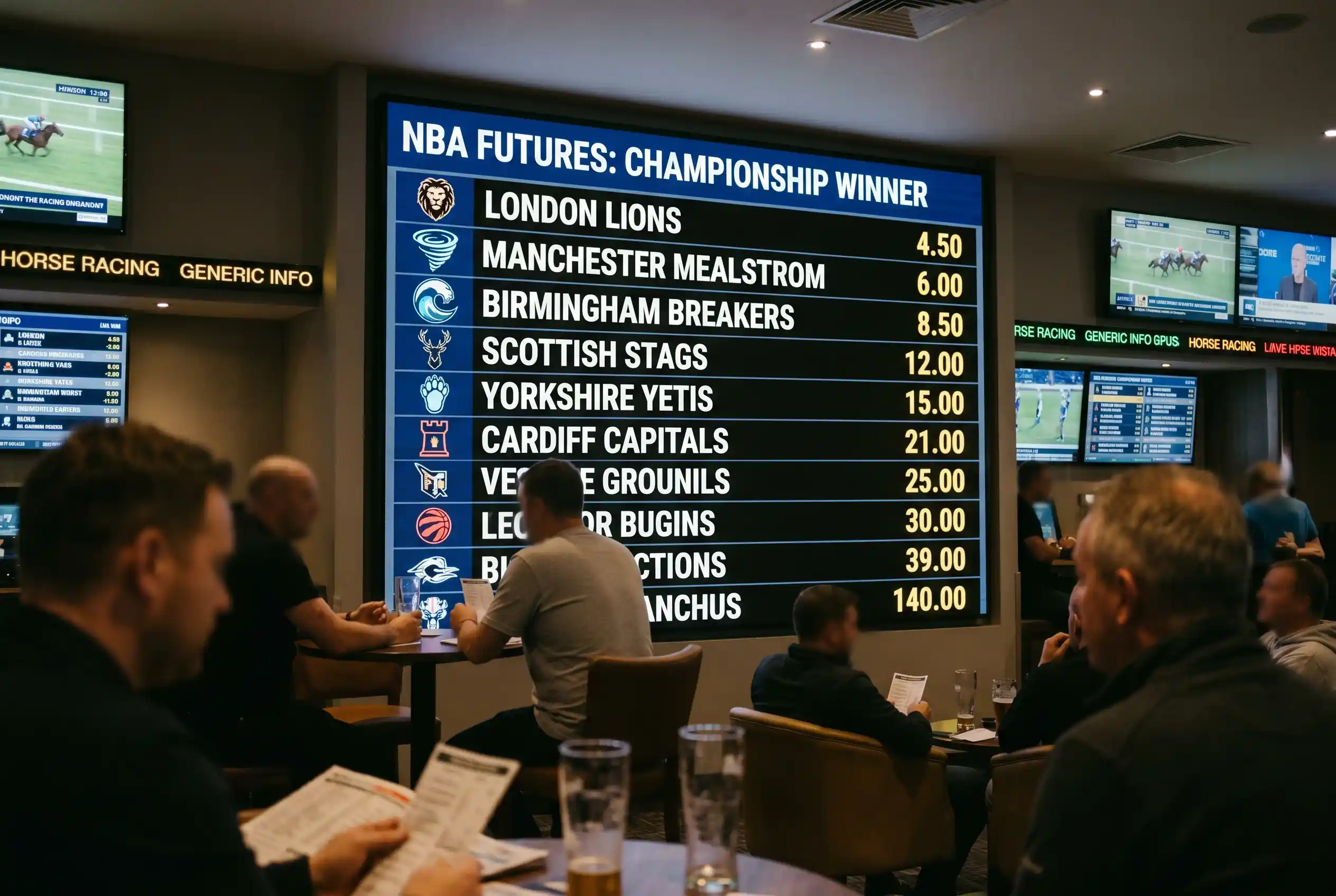
The championship futures market is the most-bet futures category in NBA, and it is also the most opaque in terms of pricing. The board lists every team, with prices ranging from a current dynasty favourite around 2.50 to a bottom-rung lottery team at 1000.00 or longer. The casual punter scans for value by looking for prices that seem long relative to their gut feeling about the team. The serious punter does the math.
The first thing to do is convert every price on the board to implied probability and sum them. The total will exceed 100 percent meaningfully – typically 130 to 150 percent depending on the book and the time of year. That excess is the book’s combined margin across the market. The next step is to devig each team’s probability by dividing by the total. The result is the no-vig fair implied probability for each team.
The team you are considering betting needs to have a true championship probability you estimate at meaningfully higher than its devigged price. “Meaningfully higher” on a futures bet usually means 3 to 5 percentage points or more, because the wider margin means small edges are not enough to overcome the long-horizon variance.
The teams that most often look like value on the championship board are the second-tier contenders – the books that sit at 12.00 to 25.00 preseason, where the prices reflect a meaningful but not dominant championship probability. These teams are typically priced based on the book’s model plus the volume of recreational action that flows to the more visible favourites. A second-tier contender whose price has not absorbed enough action may sit at a price 30 to 50 percent longer than their genuine probability would justify.
The teams that almost never offer value on the championship board are the long-shot favourites – the books at 4.00 to 8.00 that everyone is talking about. These teams attract heavy recreational money and the books trim their prices accordingly to balance liability. The headline favourites are usually priced fairly or slightly worse than fair, regardless of how strong the team looks.
Season Win Totals and the Pricing Asymmetry
The season win total market is the second-largest futures category and the one where I have found the most consistent edge over the years. The book posts an over-under on each team’s regular-season win total – 49.5 for a contender, 33.5 for a rebuilding team – and the bettor takes the side they believe more likely.
The pricing asymmetry that creates value here is the recreational bias toward overs. Casual bettors prefer to bet that good teams will be even better and that bad teams will improve from the year before. The volume on overs typically exceeds the volume on unders across the win-total board, and the book adjusts prices accordingly. The result is that under prices on heavily over-bet teams often carry meaningfully more implied probability than the genuine probability of the under landing.
The teams most often mispriced on win totals are those with significant roster turnover in the offseason. A team that lost a star in free agency but kept the same core may have a win total set 4 to 6 wins below their previous season, but the book’s model often under-adjusts for the specific loss because the recreational narrative is that the remaining core can carry the team. The under in these scenarios is sometimes a clean structural play.
Conversely, teams whose star returns from injury after missing significant time the previous season often have win totals set above the model’s true projection, because the recreational narrative inflates the perceived upside. The under can again be value, against the headline narrative.
The catch with season win totals is that they resolve at the end of the regular season, which is six to eight months after most bets are placed. The position is illiquid – you cannot easily exit it – and the bankroll commitment is meaningful. Win totals are bets for the patient bettor who can afford to leave capital tied up for the better part of a year.
UK NBA viewership has expanded meaningfully – Sky Sports’ NBA audience grew 40 percent in a recent reporting period, and Prime Video Europe saw a 444 percent surge in UK viewership year-on-year. Futures markets benefit from the engagement because the audience cares about season-long narratives.
Why Patience Beats Cleverness on Futures
The hardest lesson I have learned on futures is that the bets that look obviously clever rarely pay. The bets that pay are the ones placed early on a thesis that requires patience to play out, with stake sizing that respects the long horizon and the wide market margin.
My futures stakes are typically 1 to 2 percent of bankroll per ticket, against the 2 to 3 percent I use on single-game bets I have a strong read on. The smaller sizing reflects the wider variance, the longer hold period, and the higher probability that some piece of new information will undermine the thesis between placement and resolution.
The other discipline is to write down the thesis at the time of placement. Why this team, why this price, what would have to happen for the bet to lose, what would have to happen for it to win. Six months later, when the team’s situation has shifted multiple times and the price has moved, the original thesis is the only honest reference point for deciding whether to hold, hedge, or exit. Without the written thesis, the bettor relapses into post-hoc rationalisation about a bet they no longer remember why they placed.
The other place patience pays is in the post-deadline window. The trade deadline in February shifts the market sharply, and the prices that emerge in the week after the deadline can include meaningful overcorrection on both sides. This is one of the cleanest windows for new futures position entry in the entire season.
Where to Take the Futures Conversation Next
The championship market is the headline product, but the individual award markets are where the analytical work often pays best. MVP, Defensive Player of the Year, Rookie of the Year, Sixth Man – these markets have smaller fields, sharper analytical pathways, and tighter pricing windows than the team championship market. The architecture of how I evaluate award futures, particularly the MVP market where narrative drives so much of the price action, sits in the MVP futures piece next.
Building Futures Into a Season Strategy
The way I deploy futures into my overall NBA strategy is to treat them as a parallel track to game-by-game betting, not a substitute for it. The futures positions provide season-long narrative engagement and analytical depth, while the game-by-game work generates the bulk of the in-season profit and loss volatility. Both lanes feed each other – the futures research informs game-line reads on specific teams, and the game-line tracking informs how futures positions are managed.
The result is a betting practice that engages with NBA at multiple time horizons simultaneously. The discipline of doing both is more demanding than single-game betting alone, but the analytical breadth pays in the long run, both in monetary returns and in the deeper understanding of the sport that comes from caring about its season-long stories as well as its nightly outcomes.
Preseason for the most price flexibility, post-trade-deadline for the most information. The window between mid-July and mid-October typically offers the longest prices on contenders before recreational money compresses them. The window after the February trade deadline often produces overcorrections in both directions that resolve over the following weeks. It depends on the ticket size relative to your bankroll and your tolerance for a binary outcome. A futures ticket worth 30 percent of bankroll at the conference finals is a position most bettors should consider hedging partially. A ticket worth 3 percent of bankroll is small enough to ride out, since the all-or-nothing variance fits within normal stake-sizing parameters.When is the best time to place an NBA championship futures bet?
Should I hedge a winning futures ticket during the playoffs?
Written by the editors at nba Betting Expert.